Imposter Game vs Undercover vs Spyfall
Imposter Game vs Undercover vs Spyfall: I once spent forty minutes in a group chat arguing with six friends about who the “impostor” actually was, and it turned out to be my cousin, who had been lying so smoothly I genuinely wanted to check his phone for a script. That night is basically why I fell down this rabbit hole of comparing deception party games in the first place.
Quick Answer:
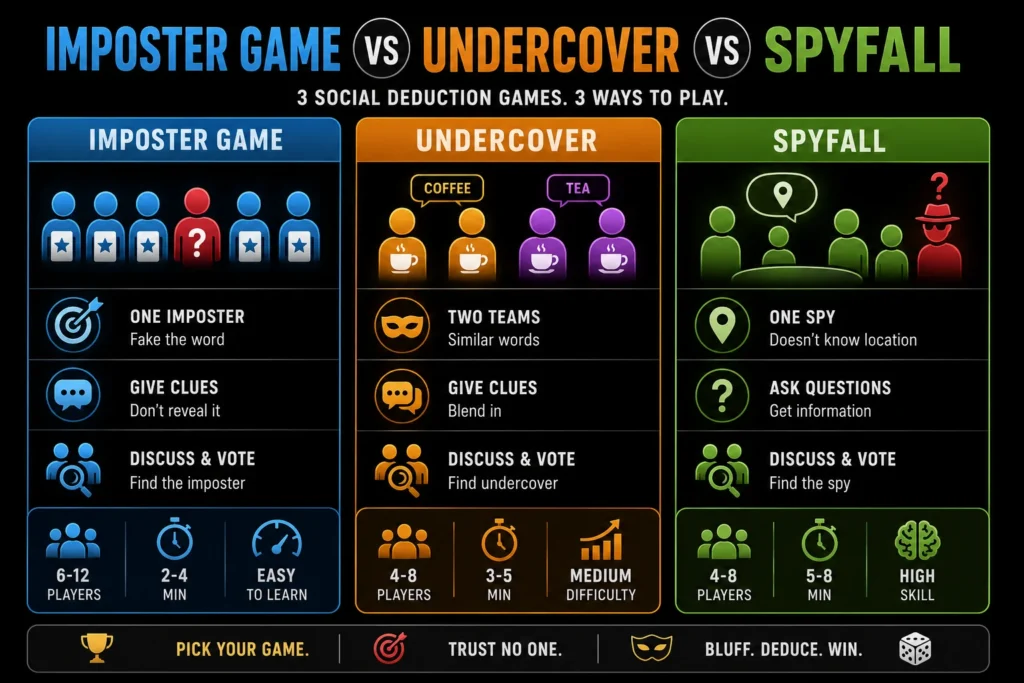
Imposter Game, Undercover, and Spyfall are all social deduction games built around hidden roles, but they work differently. Imposter Game gives most players a shared word while one person fakes it. Undercover splits players into two secret teams with slightly different words. Spyfall hides one spy inside a group that doesn’t know the shared location. If you want fast rounds with strangers, Imposter Game usually wins.
What Each Game Actually Is
Let me explain the basic setup first, because people mix these up constantly.
In an Imposter Game, everyone gets the same secret word except one or two players, who get nothing (or a fake hint). Everyone describes the word using clues, and the group votes on who seems clueless. It’s simple enough to explain to a group of strangers in under sixty seconds.
Undercover works a little differently. Two players get a “civilian” word, and one or two others get a similar but distinct “undercover” word, think “coffee” vs. “tea.” Nobody knows their word is different at first. That subtle mismatch is the entire game.
Spyfall throws everyone into a shared location: an airport, a submarine, a casino, except the spy, who has no idea where they are. Players ask each other location-specific questions, and the spy has to bluff their way through without getting caught. Honestly? Spyfall has the steepest learning curve of the three, but it rewards clever players the most.
How the Deception Actually Plays Out
Here’s the thing: the deception mechanic is what actually separates these games, not just the theme.
In Imposter Game, deception is about the information gap. You either know the word or you don’t, and your job is to fake knowledge convincingly. It’s blunt, fast, and works great over a voice call or
Undercover is subtler. Both sides think they have the same word as everyone else, so nobody’s actively lying at first; they’re just describing a slightly different thing without realizing it. That confusion is the fun part.
Spyfall flips the whole structure. Instead of one word to hide, there’s an entire scene to reconstruct through questions. The spy is guessing constantly, and everyone else is trying not to accidentally reveal the location through their answers. It’s less “who’s lying” and more “who doesn’t actually know what’s going on.”
And that’s exactly why groups who love bluffing prefer Undercover, while groups who love interrogation-style questioning lean toward Spyfall.
Which Game Wins for Your Group
So which one should you actually play tonight?
For a large casual group, say, 8 to 12 people at a party, Imposter Game online tools handle it best because rounds finish in two to three minutes. Nobody’s sitting around waiting.
For a tight group of 4-6 friends who like slower, sneakier gameplay, Undercover shines. The pacing rewards close attention, which works better with people who already know each other’s speech patterns.
Spyfall genuinely needs players comfortable with improvisation. If your group includes people who freeze up when put on the spot, this one can drag.
|
I’ll be honest, I default to Impostor Game most weeknights simply because nobody has the patience for an eight-minute Spyfall round after 10 pm.
Word Wizards and Sneaky Trades
Quick tangent: I briefly got obsessed with competitive Scrabble apps last year, thinking the strategy would translate over. It really didn’t bluffing games and word-optimization games use completely different parts of your brain. Anyway, back to imposters and spies.
Pro Tips for Playing Like You’ve Done This a Hundred Times
- Ask open-ended clues first. In Imposter Game, vague early clues protect you if you’re the imposter, and they still sound normal if you’re not. Save specifics for round two.
- Watch reaction timing, not just words. People who need to lie usually pause half a second longer before answering; that gap gives them away more than what they actually say.
- In Undercover, don’t over-describe. A word that’s too specific instantly reveals which side you’re on. Keep clues broad enough to fit either word.
- In Spyfall, ask questions you’d only ask if you already knew the location. The spy can’t fake specificity they don’t have.
- Rotate who goes first. If the same person always starts, patterns form fast, and repeat players learn to read each other too easily.
Mistakes That Ruin the Round Every Time
Actually, scratch that. Let me back up, because this mistake deserves its own sentence: overexplaining your clue. The moment someone gives a suspiciously detailed answer, the table turns on them immediately, guilty or not.
Another one: voting based on friendship instead of evidence. It happens every single time someone protects their buddy purely out of loyalty, and the actual imposter walks free. Frustrating to watch, honestly.
Rushing the discussion phase is a big one, too. Groups that skip straight to voting after one round of clues miss half the information they need. The timing matters. A lot, actually.
Last mistake playing with a group that’s too large for the game type. Cramming fourteen people into a Spyfall round means half of them barely get to speak, and the spy coasts through untouched.
Frequently Asked Questions
Final Thoughts: Imposter Game vs Undercover vs Spyfall
Picking between Imposter Game, Undercover, and Spyfall really comes down to how much patience your group has and how sneaky everyone’s willing to be. Imposter Game wins on speed and simplicity. Undercover rewards subtlety. Spyfall demands real improvisation skill.
Try starting with Imposter Game if your group’s new to this genre, then work up to Spyfall once everyone’s comfortable bluffing under pressure. Your next game night probably needs one of these, just maybe not all three back to back.