Imposter Game for Parties: Complete Guide
Nobody plans to spend forty minutes arguing about whether “lukewarm” is a valid clue for “bath.” But here we are. The imposter game for parties has this weird ability to turn a quiet living room into a full courtroom drama, and honestly, that’s exactly why it keeps showing up at every gathering I’ve been to lately.
Quick Answer:
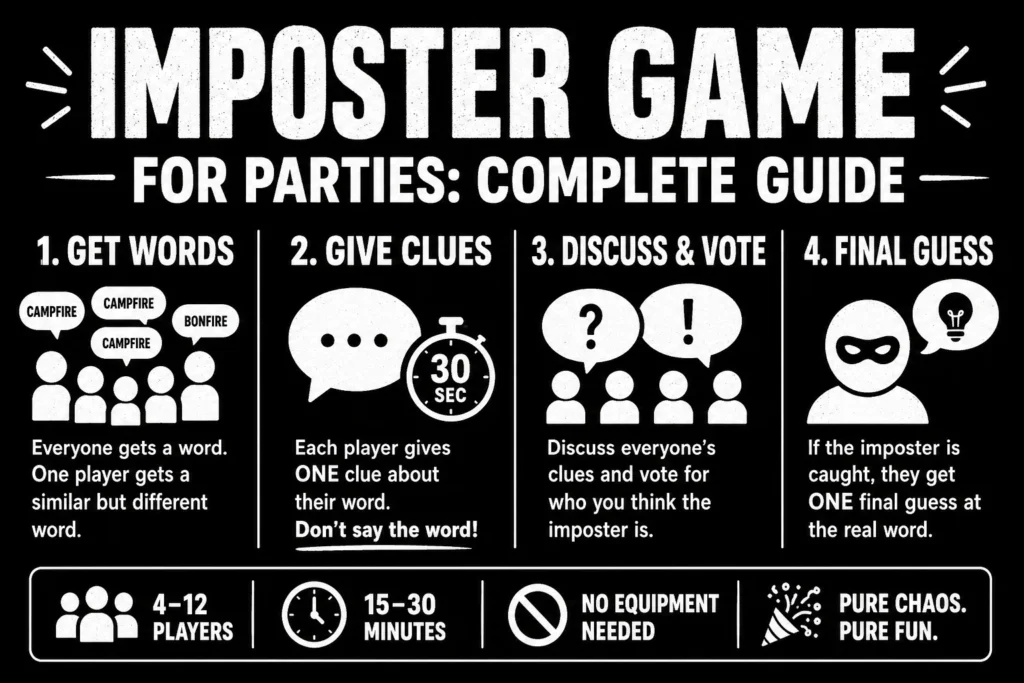
The imposter game for parties is a social word deduction game where most players share a secret word while one player, the imposter, receives a different, similar word. Players take turns giving clues without revealing the word directly. The imposter must blend in while others try to expose them. It works for 4–12 players and needs zero equipment.
How the Imposter Game Actually Works at a Party
Strip it down, and the imposter game is beautifully simple. Everyone gets a word to say, “Campfire.” All but one player shares that word. The odd one out gets something close but wrong, maybe “Bonfire” or “Candle.” Nobody knows who has what.
Each player gives exactly one clue about their word. The trick is making your clue convincing without being so obvious that you hand the imposter a free pass. After everyone speaks, the group votes on who they think the imposter is.
Here’s the thing: the imposter doesn’t lose if they get voted out. They get one final guess at the real word. Guess correctly, and they steal the win. So even a caught imposter can flip the whole result in the last second, which keeps every player tense right until the end.
What I love most about this format at parties is the built-in debate. The voting round alone, where everyone justifies their suspicion, usually takes longer than the actual clue round. And that debate? That’s where the entertainment really lives.
Why This Game Hits Different With a Crowd
Most party games either need too much setup or fall apart with more than six people. The imposter game for parties doesn’t have that problem.
With eight or ten players, the clue round becomes genuinely unpredictable. More players mean more noise, more misdirection, and more chances for the imposter to hide inside a crowd of vague answers. A clue that would immediately expose you in a three-player game becomes perfectly camouflaged in a group of nine.
And here’s something I noticed after playing this at maybe a dozen different parties: the game changes personality based on who’s in the room. Play it with coworkers, and everyone’s weirdly professional about their clues. Play it with old friends, and someone will inevitably use an inside joke as a clue, which accidentally reveals the word to half the table and causes ten minutes of fake outrage.
The social deduction element hits harder in larger groups because trust becomes more complicated. You can’t read everyone at once. You end up watching people’s faces during other people’s clues, trying to catch a flicker of recognition or a flash of panic.
That’s the psychological hook that makes this game genuinely replayable.
Setting Up the Perfect Party Round
Setup takes about ninety seconds once everyone understands the basic rules. The part people underestimate is word selection; it makes or breaks the round.
Good party words share one key quality: they’re familiar enough that everyone can clue them in, but not so obvious that the imposter’s fake word is immediately obvious. “Pizza” and “Flatbread” work great. “Elephant” and “Hippo” are both big animals, both grey-ish create the right amount of confusion.
For larger parties, I’d suggest splitting into two groups of six rather than running one massive group of twelve. The clue rounds get slow when fifteen people all need a turn, and attention drifts. Two parallel games actually create more energy; there’s a competitive element between tables, and you can compare results at the end.
Actually: scratch that. If your venue allows it, run both groups simultaneously and then bring everyone together for a cross-table final round. The winning imposter from each group faces off. It sounds chaotic. It absolutely is. It’s also the most fun I’ve had at a house party in years. (I once tried to organize a tournament bracket for this game. My friends staged an intervention.
One more thing: designate someone as the word-giver who sits out each round. Rotating this role keeps it fair and gives people a break between intense rounds.
Party Host Playbook: Tips to Keep Energy High
- Start with an easy word round. Don’t open with a tricky word pair when half your guests are still holding drinks and figuring out the rules. Use something universally familiar, “Coffee” vs “Tea,” or “Pizza” vs “Flatbread.” Easy first rounds build confidence and get people comfortable with the format before things get competitive.
- Read the room before adding rule variations. House rules like “the imposter gets two guesses” or “civilians can ask one direct question” sound fun in theory. Introduce them too early, and you’ve confused half the room. Wait until round three or four, when everyone knows the base game cold.
- Use a timer for the clue round. Without a timer, some players overthink their clue for three minutes while the energy bleeds out of the room. Thirty seconds per clue keeps things moving and adds pressure, which honestly produces better (and funnier) answers anyway.
- Assign a “judge” for disputes. Disputed clues are inevitable at parties. Someone will give a clue that technically reveals too much, or someone will accuse another player of stalling. Having one designated judge per round, the word-giver works perfectly to avoid arguments that kill momentum.
- End on a high note, not a long one. The best party game sessions stop while people still want more. If energy is peaking around round six, that’s your exit point. Pushing to round ten because “just one more” almost always produces a flatter ending than stopping at the right moment.
Rookie Errors That Flatten the Fun
Explaining the rules for too long
The imposter game for parties is intuitive, but only if you demonstrate it instead of describing it. Run one practice round with the word revealed to everyone. People learn ten times faster by watching a round play out than by listening to a five-minute explanation.
Letting one person dominate the voting debate
At parties, there’s always one person who turns the voting round into a monologue. It’s fun for about forty seconds. After that, it drains everyone else’s energy and turns the debate one-sided. Keep votes moving — give each player thirty seconds to make their case, then vote.
Using inside jokes as clues
This one’s tempting, especially with close friend groups. The problem is that an inside joke clue either gives the word away to people who get the reference or completely confuses people who don’t. Either outcome breaks the game. Keep clues universally interpretable.
Skipping the imposter’s final guess
A lot of groups forget or skip the caught imposter’s chance to guess the real word. This is one of the best moments in the entire game. The imposter guessing correctly after being exposed is a dramatic comeback that people talk about for the rest of the night. Never cut this part.
Frequently Asked Questions
Final Thoughts
The imposter game for parties works because it doesn’t need anything: no board, no cards, no special setup. Just people, a word, and the deeply human instinct to figure out who’s lying.
Get the word selection right, keep the rounds moving, and give the imposter their final guess every single time.
The rest takes care of itself. Usually loudly.