Best Categories for Imposter Word Game
Best Categories for Imposter Word Game: My worst imposter game round lasted four minutes. The category was “kitchen items,” and within two clues, everyone had basically said the same thing. Round over. Nobody happy. That’s what a bad category does to an otherwise great game. Pick the right one, and the same group of people will argue for ten minutes about whether someone’s clue was suspicious or just badly worded.
Quick Answer:
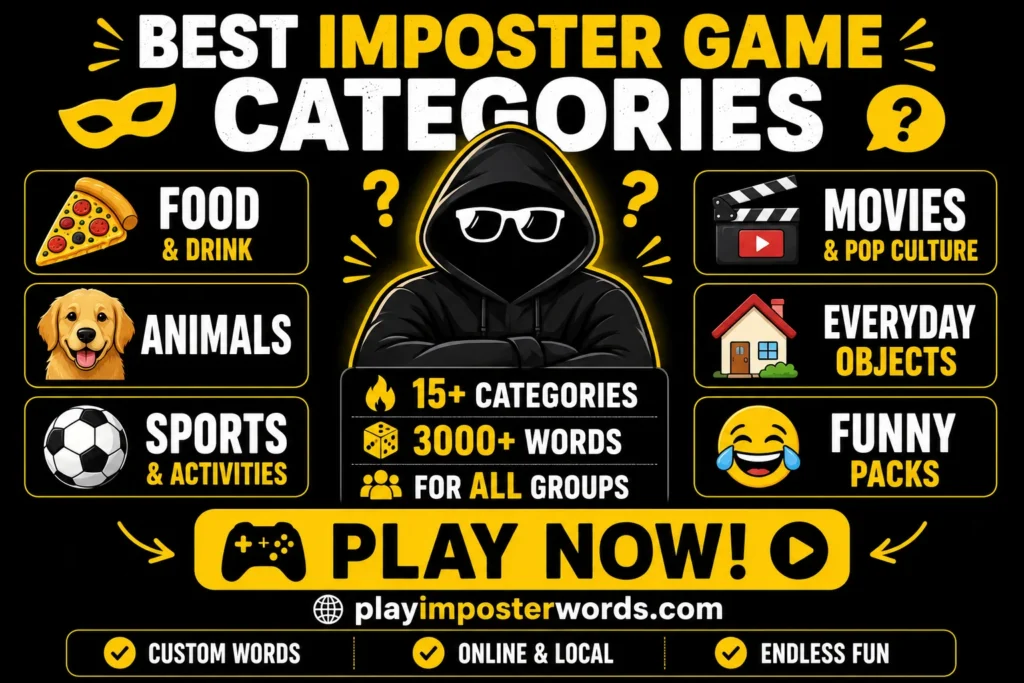
The best categories for the imposter word game are ones that everyone knows, but can describe food, animals, sports, movies, and everyday objects are the top performers. Categories with too-obvious clues end rounds fast. Categories with rich description potential create longer, messier, more fun rounds. playimposterwords.com offers 15+ built-in categories plus custom word support.
Why Category Choice Makes or Breaks the Round
The category isn’t just a setting you click past before the game starts. It determines how long the round lasts, how heated the discussion gets, and whether the imposter has any realistic chance of surviving past the first vote.
Here’s the thing: a good category for the imposter word game has one specific quality a range of description. If every player gives the same type of clue, the round collapses fast. When the word is “apple,” and four players in a row say “fruit,” the imposter either guesses immediately or gets exposed immediately. Either way, nobody has fun.
The categories that work best are ones where players naturally describe things differently. One person hears “pizza” and thinks about the smell. Another thinks about the base. A third goes straight to the emotional memory of eating it at 2 am. Those different angles create doubt, and doubt is what makes the imposter game actually interesting.
PlayImposterWords.com has mapped this well; their 15+ built-in categories aren’t random. Food, animals, sports, everyday life, and themed packs all share that quality of multi-angle description. That’s not an accident.
Top Categories for Imposter Word Game
Some categories consistently outperform others regardless of who’s playing. These are the ones worth starting with.
Food and Drink is the most reliable category in the game, full stop. Words like espresso, avocado, sushi, or croissant are universally recognizable but rich enough to describe from completely different angles: appearance, smell, texture, cultural association, and occasion. The imposter has enough to bluff with. Civilians have enough variety in their clues to create suspicion. Rounds last the right amount of time.
Animals work for every age group and every setting. The key is choosing specific animals over generic ones. “Dog” is too easy. “Flamingo,” “pangolin,” or “sloth” creates the right tension; everyone knows what it is, but describing it without saying the obvious things takes actual thought.
Sports and activities bring high energy to rounds and work especially well when the group shares a sporting culture. Words like “penalty kick,” “slam dunk,” or “marathon” generate passionate clues and passionate disagreements. The problem, and this is worth knowing, is that sports categories can disadvantage players who don’t follow sports at all. Read the room before choosing this one.
Movies and Pop Culture is the highest-variance category. When it lands, it creates some of the funniest rounds you’ll play. When it doesn’t, when half the group hasn’t seen the same things, it falls flat. Best used with groups who have overlapping cultural references.
| Category | Best For | Risk Level |
| Food & Drink | All groups, all ages | Low |
| Animals | Mixed age groups | Low |
| Sports | Sports fans, office teams | Medium |
| Movies / Pop Culture | Friend groups, same generation | High |
| Everyday Objects | Party games, beginners | Low |
| Funny / Themed Packs | High-energy groups | Medium |
Categories by Group Type Match the Crowd
This is the part most people skip, and it’s where rounds go wrong. The best imposter word game categories aren’t universal; they’re contextual.
For kids and family groups
Stick to food, animals, and everyday objects. These categories have words that feel familiar and safe, and the descriptions stay light. Nobody gets stuck, nobody feels excluded, and the imposter has enough material to bluff without needing specialist knowledge.
For office teams
Everyday objects and sports work well. Actually, scratch that, everyday objects work better because they level the playing field across departments. Someone in accounting and someone in design both know what a stapler is. The humor of describing a stapler without saying “stapler” is genuinely funny regardless of your job title.
For friend groups on a video call
Food, pop culture, and funny-themed packs are the sweet spot. These categories generate the most chat in the discussion phase, which matters when you’re playing remotely, and silence feels awkward.
How to play the imposter game online with friends
For large parties (10+ people)
Go broader. Categories with widely recognizable words — animals, food, everyday life keep everyone in the conversation. Niche categories in large groups create a two-tier experience where some players confidently give clues and others nervously bluff through both roles.
Custom Categories: the Secret Weapon Most Players Ignore
PlayImposterWords.com lets you add custom word pairs directly into the generator, and this feature is genuinely underused by most players.
The format is simple: “Word1 / Word2”, one pair per line. The generator treats your custom pairs exactly like the built-in categories. What this opens up is enormous. You can create a category built entirely from inside jokes in your friend group. You can run a Harry Potter-themed round. You can use workplace references that only your team would get.
The timing matters. A lot, actually. Custom categories hit hardest when they’re unexpected, when nobody knows you’ve loaded personal references until the first clue lands, and half the table immediately knows what the word is, and the other half is completely lost. That gap between who knows and who doesn’t is exactly where the best imposter game moments live.
(I once used local restaurant names as a custom category with a group of friends from the same city. The round descended into a fifteen-minute argument about whether a particular clue about “great parking” was suspicious. It was the best round we ever played.)
Back to the point: custom categories also solve the problem of repetition. Once you’ve played the built-in categories enough times, certain words start repeating. Custom input refreshes the whole experience without needing a different tool.
Tips for Picking Categories Like a Pro
- Start with food for first-time groups every single time.
It’s not the most exciting category, but it’s the most accessible. First rounds should feel easy enough to understand the game mechanics. Food gives players enough material to describe without overwhelming them. Once the rhythm is established, switch to something trickier. - Match category difficulty to round number.
Round one: easy category. Round three or four: push into territory where clues get harder to give. By the time players are warmed up, they can handle categories that require more lateral thinking. Starting hard makes new players feel incompetent rather than engaged. - Use funny-themed packs when energy is dropping.
Every game session has a lull, usually around round four or five, when the novelty fades. A well-timed funny category resets the energy. The absurdity of describing something ridiculous breaks the pattern and pulls people back in. - Rotate categories without repeating back-to-back.
Two food rounds in a row make players predict the category, which helps the imposter and hurts the round. Keep categories unpredictable by switching themes every round. Unpredictability is the point. - Let different players choose the category each round.
The person who always picks food will keep picking food. Rotating category selection introduces variety and gives quieter group members a moment of low-pressure decision-making. Small thing. Noticeable impact on how the session flows.
Category Mistakes That Kill the Vibe
Choosing niche categories for mixed groups
A “90s video games” category is incredible with the right group. With a mixed-age group, it hands the imposter the easiest round of their life; they can’t bluff what they don’t recognize, and civilians give clues so specific that the word becomes obvious. Niche categories require niche audiences.
Sticking to the same category for the whole session
And this one happens constantly. One category goes well, so the host keeps it running for five rounds in a row. By round three, players have developed shorthand for describing everything in that category, which makes the imposter’s job easier and the rounds shorter. Mix it up.
Picking categories where the words are too similar
Some categories have words that are so closely related that the imposter’s similar word becomes basically the same clue as the civilian word. The game loses tension when that happens. The best categories have words distinct enough that the imposter genuinely has to perform.
Questions Players Ask About Imposter Game Categories
Final Thoughts
Category selection is the difference between a round that’s over in three minutes and one that’s still being argued about twenty minutes later. Start with food, rotate deliberately, and use custom words when the built-in options start feeling predictable.
Head to playimposterwords.com, pick a category that fits your group, and set a two-minute discussion timer. The first round takes ninety seconds to set up.
The right category doesn’t just start the game; it decides what kind of game you’re playing.