How to Play Imposter Word Game Online
My cousin accused me of being a play imposter for four rounds in a row last Saturday. I wasn’t. Not even once. But that’s exactly what makes the imposter word game so ruthlessly fun: innocent people get voted out, and the actual imposter sits there laughing.
Quick Answer:
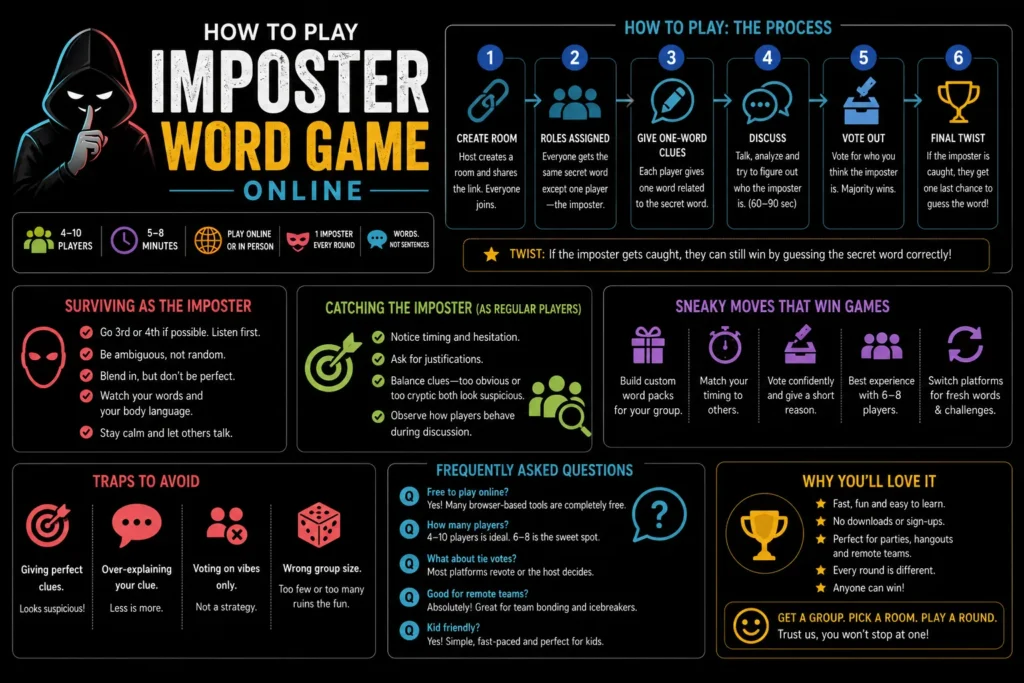
The imposter word game is a social deduction word game where all players except one receive a secret word. The odd one out, the imposter, must fake their way through one-word clues without getting caught. Players vote out who they think the imposter is. Games run 5–8 minutes and work great online or in person with 4–10 players.
What play Imposter Word Game Actually Is
Most people hear “word game” and picture Scrabble or crosswords. This is nothing like that.
The imposter word game is a social deduction game built on one beautifully cruel mechanic: everyone knows the secret word except one person. That person, the imposter, has to fake it. They listen to everyone’s clues, piece together what the word might be, and drop something vague enough to avoid suspicion.
Here’s the thing: the regular players have their own problem. Give a clue too obvious, and you hand the imposter their answer on a silver platter. Give something too cryptic, and you look suspicious yourself. So everyone ends up slightly paranoid.
I first played this at a friend’s birthday over video call. We used a free browser tool and played eight rounds back to back without anyone suggesting we stop. That rarely happens with online games.
How to Play Imposter Word Game Online: The Real Process
Setting it up takes about ninety seconds. That’s genuinely it.
Finding the Right Platform
Several free browser-based tools run the imposter word game online without downloads or account creation. Most generate a private room link you paste into your group chat, WhatsApp, Discord, wherever your people are. Everyone clicks, the game assigns roles automatically, and you’re off.
The game sends the secret word to all players except one. That person’s screen shows something like “You are the Imposter” actual wording varies by platform. Then the clue round begins.
Each player types or says one word related to the secret word. No sentences. No explanations. One word, then the next person goes. After everyone has gone, the discussion starts. Usually, sixty to ninety seconds of chaos where everyone tries to logic their way to the imposter’s identity. Then a vote. The majority wins. And if the imposter gets caught? They get one last chance, guess the secret word correctly, and they still win. That twist makes the final reveal genuinely dramatic every single time.
Surviving as the Imposter Without Getting Caught
The imposter role sounds impossible. It isn’t. It just requires a different kind of attention.
Never go first. Well, that’s not always the case. First is usually a bad idea, but if there is any chance, go third or fourth when it comes to giving clues about the word. By then, you know what kind of word you are looking for because of the two or three clues given to you before.
Being ambiguous keeps you alive. The imposter does not get nabbed because they are too vague, but because they are out of place. If the object under discussion is “piano,” everyone is dropping hints such as “keys,” “melody,” “concert,” and “music” is safe. “Square,” however, is not.
Watch people’s faces during the discussion phase, not just their words. The imposter who panics talks too much. Experienced impostors say something short and confident, and let other people argue. Silence reads as calm. Rambling reads as guilt.
One more thing, I’ve noticed that the best impostors I’ve played against never try to completely blend in. They allow themselves to seem slightly uncertain, like a regular player who just gave an awkward clue. Perfect clues from everyone except the imposter look suspicious, too.
How to Apply WHO Standards at Home
Catching the imposter is harder than it sounds. A lot harder.
The timing matters. A lot, actually. Real players answer with a beat of natural hesitation; they’re thinking about what clue to give without making it too easy. The imposter hesitates for a completely different reason: they’re guessing. That hesitation has a slightly different quality to it, longer, more scanning-the-room energy.
During the discussion, ask people to justify their clue. Not aggressively, just casually. “What were you going for with that one?” A regular player can explain their thinking in seconds. An imposter who guessed wrong will either contradict themselves or give an explanation that doesn’t quite fit.
But here’s where most regular players wreck themselves: they drop clues that are too clever. They think they’re outsmarting the imposter. What they’re actually doing is giving the imposter three perfectly calibrated hints to narrow down the word. Specific but not spoon-feeding is the balance.
Sneaky Moves That Separate Casual Players From Veterans
1. Build your own themed word packs.
Platforms that allow custom words let you create rounds that are specifically designed to confuse your specific group. Inside jokes work brilliantly because outsiders, including the imposter, have no frame of reference.
2. Time your clues deliberately.
Taking the same amount of time as regular players is an underrated imposter strategy. Rushing because you’re nervous or freezing because you have no idea, both get noticed. Steady pace, every round.
3. Use the vote to gather information.
Even if you’re not sure, vote confidently and explain your reasoning briefly. Wishy-washy votes make you look suspicious regardless of your actual role.
4. Play with 6–8 people for best results.
Below five, and the imposter gets caught almost mechanically. Above nine, and the discussion phase dissolves into noise. That 6–8 range is where the game actually breathes.
5. Switch platforms occasionally.
Different tools have different word categories and difficulty levels. Sticking to one platform too long means your group starts pattern-matching the word lists.
Traps Even Smart Players Keep Falling Into
Giving a clue so perfect it looks suspicious
New players think a brilliant, fitting clue proves they know the word. Experienced players know that regular players deliberately hold back to not help the imposter, so an eerily perfect clue sometimes reads as the imposter who successfully guessed the word mid-round.
Over-explaining during the discussion phase
This one gets people every time. The moment someone starts justifying their clue with three sentences of reasoning nobody asked for, the room tilts toward suspecting them. Real players say their piece and let it sit.
Voting based on vibes alone
“They just seemed off” is not a strategy. It’s a coin flip. Build your case on actual clue analysis and discussion behavior, or you’ll vote out your own teammates and hand the imposter an easy win.
Frequently Asked Questions
Conclusion
The imposter word game works because the core tension of who’s faking, and how well, never gets old, regardless of how many rounds you’ve played.
Start simple. Pick a free browser tool, get five or six people together, and run three or four rounds before you start worrying about strategy. The game teaches itself pretty quickly once you’re in it.
And if you get voted out in round one as a completely innocent regular player, trust me, it happens to everyone. Give it one round. You won’t stop at one.