
Imposter Game for Family Night
Imposter Game for Family Night: The last time my family tried a board game on Eid night, three people quit by round two, one uncle fell asleep, and the youngest kid flipped the pieces off the table. We never touched that box again. Then someone opened the Imposter Word Game on their phone, no setup, no pieces, no instruction manual, and somehow we played for two hours straight with a 9-year-old, two teenagers, and four adults all genuinely competing.
Quick Answer:
The Imposter Word Game works perfectly for family night because it needs zero setup, runs on any phone, and scales from 3 to 99 players across all ages. Choose simple categories like Food or Animals for mixed groups, use the Pass & Play mode so one device handles everyone, and keep rounds to 2 minutes for non-stop energy.
Imposter Game for Family Night: Why it works
Most party games fail with families because they assume everyone is on the same level. Either the rules are too complicated for kids, too boring for teenagers, or too chaotic for the adults who just want something calm after dinner.
The Imposter Word Game sidesteps all of that. The rules take 60 seconds to explain. A 9-year-old and a 50-year-old can sit in the same round, and both have a genuine shot at winning, not because the game dumbs itself down, but because social reading is a skill that doesn’t require any particular age or background.
Here’s the thing: the game scales naturally. A kid might give an obvious hint and still survive because adults overthink the vote. A grandparent might read body language better than anyone in the room. Teenagers who spend all day performing for each other on social media often make terrifying impostors.
And the Pass & Play mode at playimposterwords.com means you need exactly one phone. No app download. No accounts. No one needs their own device. You pass it around the circle, everyone peeks at their role secretly, and the game begins.
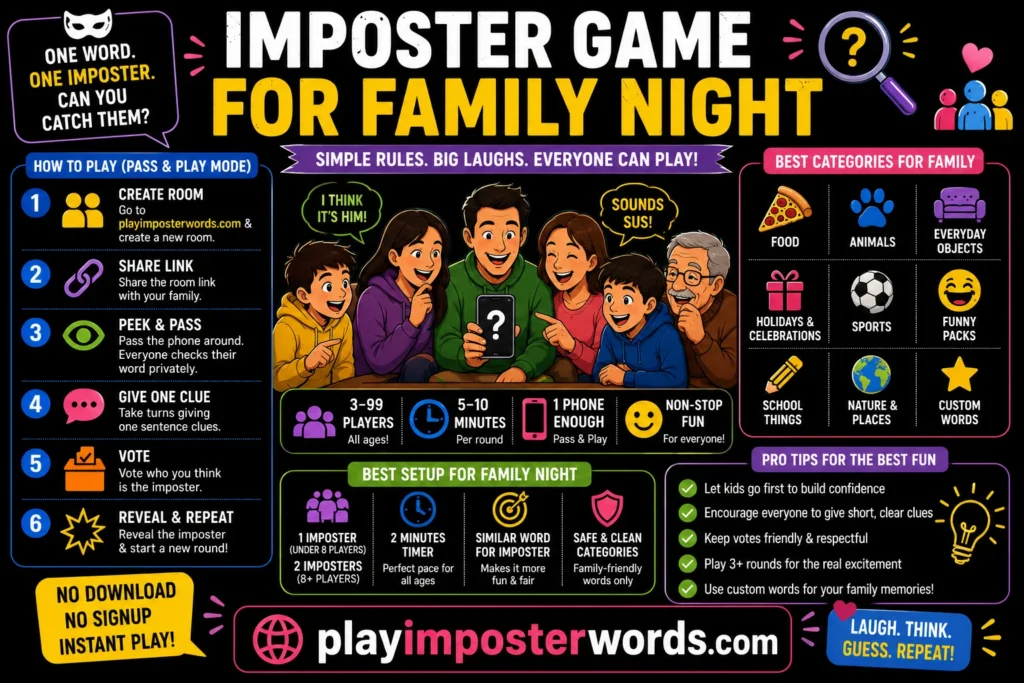
Best Setup for Family Night Age Mix, Mode, and Timer
Getting the setup right matters more than anything else for a family crowd. The wrong timer setting alone can drain all the energy from the room.
Mode:
Use Pass & Play for family nights where everyone is in the same room. One phone passes around the circle, each person peeks their word privately, passes the phone face-down, and the discussion begins naturally. This works from 3 to 99 players and handles mixed group sizes without any friction.
Number of Impostors:
Start with one imposter for groups under 8. Two for larger family gatherings. Too many impostors make the game chaotic and harder for younger players to follow what’s happening.
Timer:
Set it to 2 minutes for families. Younger kids lose focus with longer timers. Adults get restless with shorter ones. Two minutes hits the sweet spot, enough time for everyone to give a hint and have a quick vote without the energy dropping.
Word Category:
Food and Animals for the first round, always. Every family member can talk about both without blanking. Save themed or harder categories for round three once everyone understands how the discussion phase works.
The “Give impostors a similar word” setting should stay on for family play. It gives the imposter a related word rather than nothing, which keeps rounds competitive for younger players who might otherwise get exposed in the first 20 seconds.
Which Categories Work Best for Mixed-Age Family Groups
Category choice is the biggest variable in whether a family round lasts 90 seconds or 15 minutes of genuine tension.
Food:
Universally, the safest opener. Every age group has something to say about Pizza vs Burger or Chai vs Coffee. Hints come naturally, nobody blanks, and the imposter has enough overlap to survive at least two rounds before getting caught.
Animals:
Slightly more dramatic than food because animal behaviour creates a very specific home territory. Dog vs Cat, Lion vs Tiger, Dolphin vs Whale. A 10-year-old who actually knows that lions live in prides will expose an imposter who said “lives alone in the jungle” faster than any adult in the room.
Everyday Objects:
Better for older family members and teenagers who want a harder round. Chair vs Stool, Pen vs Pencil, Fridge vs Freezer. The hints need to be precise, and the imposter has nowhere to hide. Save this for round three or four when the younger kids have warmed up.
Custom Words:
The secret weapon for family nights. Enter pairs like Eid vs Diwali, Wedding vs Birthday, Biryani vs Pulao, Cricket vs Football. These are things your specific family has shared memories and opinions about — and that’s exactly what makes them brutal for the imposter to fake.
Best Settings and Categories for School Groups
This is where most families hit a wall. Kids want to go fast. Teens want to compete seriously. Adults want to actually talk and enjoy the game. The Imposter Word Game handles this better than it should but a few small adjustments make it work even better.
For kids: Let them give their hint first every round. It removes the anxiety of going last and means they stay engaged instead of drifting. A kid who gives their hint early feels included in the whole discussion.
For teenagers: They’ll naturally become the most strategic players in the room. Give them the option to run the voting they love having that authority, and it keeps them from getting bored between rounds.
For adults: The discussion phase is where they shine. Adults read the room better than younger players and notice inconsistencies over multiple hints. Let the discussion phase run its full 2 minutes rather than rushing to vote adults are where the interesting accusations come from.
Actually: scratch that. Let me be more specific. The real trick for keeping everyone engaged is making sure no round ends too fast. A round that finishes in 45 seconds, because the imposter was obvious on the first hint, leaves half the family feeling like they didn’t get to play. If you notice a round going that direction, slow the vote and let more discussion happen, even if you suspect you already know.
Pro Tips: Running a Smooth Family Game Night
- Explain the rules once, then show them, don’t explain again.
The fastest way to lose a family crowd is to spend seven minutes explaining before the first round. Explain once in 60 seconds, play a demo round where everyone knows who the imposter is, then start for real. Seeing it once beats hearing about it three times. - Use the scoreboard to keep track across rounds.
The Imposter game generator shows cumulative scores after each round. Keeping the scoreboard visible, even just on the phone screen, adds competitive stakes that sustain energy across four or five rounds in a row. - Let younger players be impostors in round two.
In the first round, everyone’s learning. By round two, give a younger player the imposter role deliberately. Kids who successfully fool adults for even one round become the most enthusiastic advocates for playing again. - Create custom words from family inside jokes.
Enter Dad’s Cooking vs Mum’s Cooking. Enter Last Year’s Holiday vs This Year’s Holiday. Enter WhatsApp Family Group vs In-Person Conversation. When the word pairs come from your family’s own vocabulary, the hints get funnier, and the imposter gets exposed in ways nobody expected. - Keep the phone passing smoothly face down, every time.
- The most common mistake in Pass & Play is someone accidentally seeing another player’s screen. Establish the rule clearly before round one: peek your word, close the screen, pass it face down. No exceptions, no peeking at the person next to you. The whole game depends on it.
Mistakes That Kill the Family Round
Picking a category that half the family doesn’t know
Countries sound fun until the 8-year-old gets Portugal, and every hint is too vague for anyone to distinguish from Spain. Choose categories where every person at the table has genuine opinions and knowledge. Food, Animals, and custom family words not geography trivia.
Letting the vote happen too quickly
Someone figures out the imposter in the first hint and immediately calls for a vote. The round ends in 90 seconds. Three family members never got to give a hint. Half the table feels like they barely played. Enforce the full discussion timer even when the answer feels obvious, you’re often wrong, and even when you’re right, the discussion is where the fun lives.
Not rotating who starts the hint-giving
If the same person goes first every round, the hint order becomes predictable, and experienced players use it to read the imposter’s position based on who hesitates. Rotate starting player every round. It keeps everyone sharp and stops one person from dominating the flow.
Taking the imposter role too seriously with younger kids
Some family members, usually the most competitive adults, will interrogate a 10-year-old imposter so aggressively that the kid stops having fun. The imposter game for families works because it’s playful deception, not a courtroom. Keep the energy fun, not forensic.
Frequently Asked Questions
Final Thoughts
Family game nights fail when the game can’t hold everyone’s attention at the same time. The Imposter Word Game holds everyone’s attention precisely because it doesn’t require equal knowledge; it requires social awareness, and every family member has that in some form.
Set up Pass & Play mode, pick Food for round one, and let the first round teach itself. By round three, you’ll have custom words based on things only your family would understand and that’s when the game becomes something you come back to every time you’re all in the same room.