Custom Imposter Game Ideas: Fresh Themes That Actually Keep Players Guessing
Custom Imposter Game Ideas: Most game nights fade into obscurity around round four. Everyone’s guessed the imposter twice already and the questions get repetitive and suddenly people are checking their phones . Usually that’s not a game issue, it’s a theme issue. Custom imposter game ideas solve that and are way easier to pull off than you think.
Quick Answer:
The best custom imposter game ideas leave the typical “guess the word” format behind and choose a theme such as movie characters, food categories, or fictional jobs so that regular players can’t just memorize the pattern. The imposter gets a similar prompt, but not the same one. The group asks questions to try and expose them, and then votes are cast.
Why Themed Imposter Rounds Beat the Default Format
The thing with generic imposter games is that after a few rounds, people stop reasoning and start pattern-matching. They know that in most cases, the fake will choose vague words, so they simply vote for whoever sounds unsure. That’s no longer a deduction; that’s habit.
Custom imposter game ideas break that habit by switching the category every round. One round is “fictional villains,” the next is “breakfast foods,” the next is “jobs nobody wants.” Suddenly, muscle memory is not enough. They’ve got to really listen.
That’s the difference between a game you play once and a game that becomes a monthly tradition. I know a group of teachers who do a themed round every Friday. The theme itself starts half the conversation before anyone even begins to ask questions.
Custom Imposter Game Ideas by Category
You don’t need fancy tools for this; a shared doc, a deck of cards or even a whiteboard will work. Below are categories that appear to offer good rounds consistently.
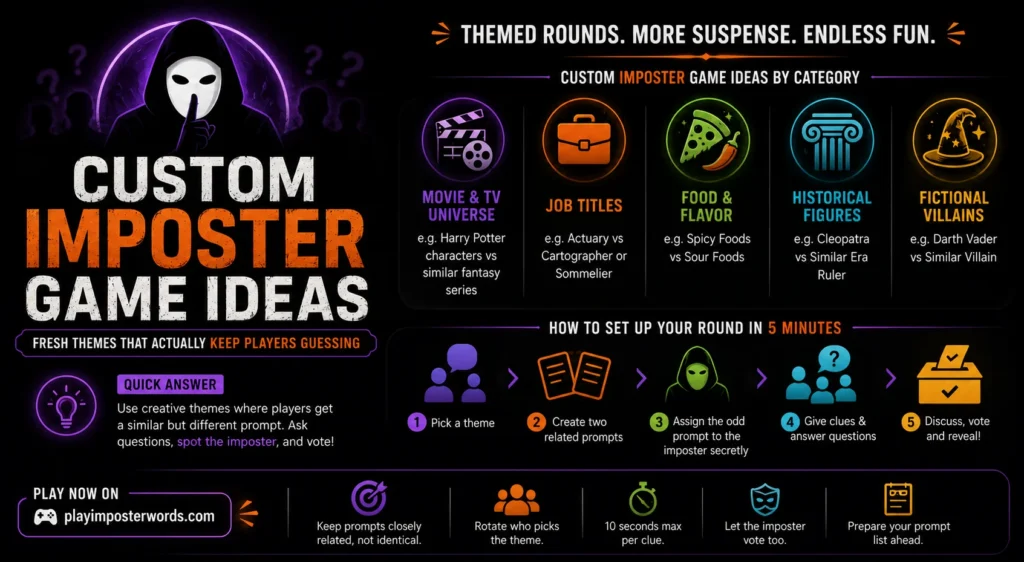
Night of the Movie & TV Universe
Everyone draws a character from the same franchise (ie., a popular fantasy series) except the imposter, who draws a character from a similar but different show. It’s close enough to fit in, different enough to trip people up.
Job Titles No One Explains Well
Think actuary, cartographer, or sommelier. Regular players describe the job without naming it. The imposter has to do a convincing job of faking it, and, honestly, it leads to some of the funniest guesses of the night.
Food and Flavor Rounds
Great for family game night since kids and adults both understand it instantly. One group gets “spicy foods,” and the imposter gets “sour foods.” Close enough to bluff, different enough to eventually slip up.
Slightly harder mode good for trivia-loving friend groups.
Slightly harder mode good for trivia-loving friend groups.
Best trivia games for adults
A short comparison of how these hold up in practice:
|
How to Set Up Your Own Round in Five Minutes
You don’t need an app for this, though plenty exist. Pick a broad theme, write two related-but-distinct prompts, and quietly assign one player the “odd” prompt without the group knowing who.
Give everyone thirty seconds to think of one clue related to their prompt. Go around the circle. After everyone’s spoken once, open the floor for questions. This is where the imposter usually starts sweating.
One thing that surprised me the first time I tried this with a mixed-age group: kids catch on to the emotional tells way faster than adults do. Adults overthink the logic. Kids just watch faces.
Tips That Actually Make Your Game Night Better
- Keep prompts close in category, not identical in difficulty. If the imposter’s prompt is too obviously different, the round ends in ten seconds and nobody has fun.
- Rotate who picks the theme each round. This keeps the game from feeling like one person’s show and adds variety you can’t predict in advance.
- Set a hard time limit per clue: ten seconds max. Long clues give away too much information and make the imposter’s job nearly impossible.
- Let the imposter vote too. It sounds counterintuitive, but letting them participate in accusations often makes their cover more convincing.
- Write your prompt list ahead of time. Coming up with themes on the spot slows the game down and usually produces weaker, more obvious pairs.
Common Mistakes That Flatten the Fun
Making the imposter’s prompt too obscure is a big one. If nobody in the group could reasonably describe the concept, the whole round turns into confused guessing instead of clever bluffing.
Another mistake is letting one player dominate the questioning. Imposter games work because everyone contributes a little suspicion. If one person runs the interrogation, it stops feeling like a group deduction game and starts feeling like an audit.
Skipping the reveal explanation is a smaller mistake, but it matters. After voting, take fifteen seconds to explain what the imposter’s actual prompt was. It’s oddly satisfying and helps everyone calibrate for the next round.
And don’t reuse the same five themes every single week. Groups get bored fast, and custom imposter game ideas lose their whole appeal once they stop feeling custom.
Frequently Asked Questions
Final Thoughts:
The whole appeal of custom imposter game ideas comes down to one thing: unpredictability. Swap themes often, keep prompts close but not identical, and give the imposter just enough rope to either succeed or completely give themselves away.
Start with one themed round this week: food or movies are the easiest entry points and see how much longer your group stays engaged. Once you build your own prompt list, you’ll never go back to the default format.
A good imposter round isn’t about tricking people. It’s about giving everyone just enough uncertainty to make the guessing genuinely fun.