
Imposter Game Rules: Complete Guide
Imposter Game Rules: I ruined a perfectly good game night once because nobody actually knew the rules. We spent twenty minutes arguing about whether the imposter was allowed to ask questions. Turns out that debate IS the game. Once I discovered the imposter word game and started using a proper generator, everything clicked.
Quick Answer:
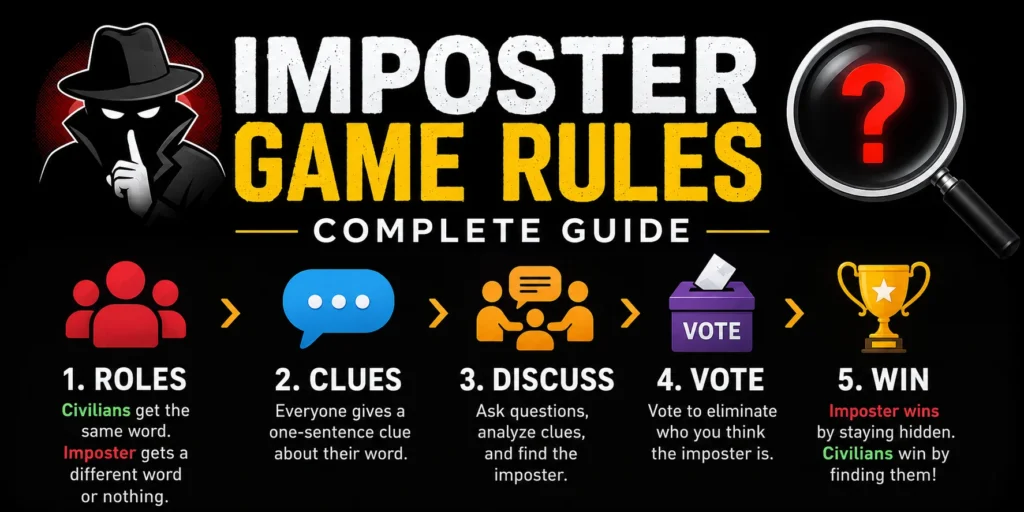
In the Imposter Game, players are secretly assigned roles as civilians or imposters. Civilians share a secret word; the imposter gets a different word or nothing at all. Everyone gives clues, discusses, and votes to eliminate who they think the imposter is. The imposter wins by staying hidden. Games work with 3 to 99 players and take 10–20 minutes.
What Are the Imposter Game Rules, Really?
Here’s the thing: most people miss the Impostor game rules aren’t complicated. They’re deceptively simple, which is exactly what makes the game so addictive.
Every player gets a secret role. The majority are civilians, who all receive the same word, say, “Pizza.” One or two players are the imposters, and they either get a similar-but-different word like “Burger,” or nothing at all. Nobody knows who got what.
Then the talking begins.
Each player gives a one-sentence clue about their word without saying it directly. Civilians try to prove they know the word. The imposter tries to sound like they do too, without actually knowing. After the clues, everyone votes. Most votes eliminate a player. If the imposter survives to the end, they win. If civilians boot them out, civilians win.
That’s it. But honestly? The tension packed into those two minutes of clue-giving is something else.
The Core Roles: Civilian vs. Imposter
The civilian’s job is to prove they know the word while being vague enough that the imposter can’t steal your clue and copy it. Too obvious, and you hand the imposter a lifeline. Too vague, and your own team suspects you.
The imposter’s job is pure bluffing. Watch everyone’s reactions, mirror confident energy, and drop just enough detail to seem legit. The timing matters. A lot, actually. If you speak too early, you’re copying others. Too late, and you look nervous.
How to Set Up and Start the Game
Setting up used to mean index cards, a moderator, and someone inevitably cheating by peeking. Now tools like playimposterwords.com handle everything automatically: roles, words, timers, scoring.
Here’s how a round starts using an online imposter game word generator:
Step 1: Choose your category
Food, animals, sports, and everyday life pick something that matches your crowd. Kids? Go with animals. Office team building? Everyday objects work great.
Step 2: Set the number of players and imposters
Three to five players usually means one imposter. Six or more? Add a second.
How many imposters per player count
Step 3: Each player secretly peeks at their word
Pass the device one at a time, or use online mode where each person gets their own screen.
Step 4: Start the discussion timer
Most games use 1–3 minutes. Enough time to get heated, not enough to overthink.
And you’re playing. Honestly, the whole setup takes under two minutes, which is why this game works so well at parties where people have zero patience for rulebooks.
The Discussion and Voting Phase: Where It Gets Spicy
Actually, scratch that. “Discussion” undersells it. This phase is social warfare in slow motion.
Once everyone has given their clue, the table opens up. Players can ask follow-up questions, challenge statements, or just stare at someone suspiciously until they crack. I’ve seen people fold under eye contact alone. No questions asked.
The voting works by majority. Everyone points or types their guess simultaneously; no influencing allowed until votes are revealed. Whoever gets the most votes is eliminated and reveals their role.
But here’s where the imposter game rules get interesting: if the imposter is eliminated, civilians must still guess the secret word to officially win. Get it wrong, and the imposter steals the round even in defeat. It’s a brilliant rule that keeps everyone invested until the very last second.
Imposter Strategy: How to Blend In (Or Catch One)
I’ve played enough rounds to notice patterns. The imposter almost always does one of two things: either overexplains (trying too hard) or gives a clue so generic it could mean anything.
“It’s something you use every day.” That’s an imposter clue. Nobody who actually knows the word would waste their turn with that.
As a civilian trying to catch the imposter, listen for:
- Clues that match every word in the category, not the specific one
- Someone who reacts to other clues before giving their own
- Unusual confidence from a quiet player or unusual silence from a loud one
And if you’re the imposter? Pick the most specific detail someone else mentioned and build on it slightly. Don’t copy word for word, evolve it. That’s what keeps you alive.
Pro Tips to Make Every Round More Fun
- Use the “similar word” setting for beginners. Giving the impostor a related word (Pizza/Burger) instead of nothing makes the game more balanced for new players. Knowing something gives them a fighting chance and more interesting bluffs.
- Set a strict clue time limit per person. Without a timer, one nervous player can stall the whole game. Fifteen seconds per clue keeps energy high and prevents overthinking.
- Rotate who speaks first each round. The first person to give a clue has the hardest job and the imposter loves going last to copy. Rotating fairness into the structure removes this edge.
- Try custom words for themed nights. Using playimposterwords.com’s custom word feature, you can add inside jokes, work references, or themed vocabulary. A “90s Movies” night hits different when the word is “Titanic,” and the impostor only got “Iceberg.”
- Play a few rounds before adding house rules. Every group eventually creates its own variations. But learn the base Impostor game rules first; otherwise, you end up in a 20-minute argument about question-asking. (Ask me how I know.)
Mistakes That Kill the Vibe (And How to Avoid Them)
Giving away the word in your clue
“It’s a round red fruit that starts with A” is not a clue it’s a forfeit. The imposter game rules exist to create tension, not remove it. Keep clues indirect.
Revealing your role after elimination before others vote
This is the biggest game-killer. If an eliminated player says “I was civilian!” before the vote ends, they immediately signal who the imposter is. Stay quiet until all votes are cast.
Skipping the civilian’s final guess
New players constantly forget that even after catching the impostor, civilians must correctly name the secret word. Skipping this step robs the game of its best twist and lets a caught imposter sneak a win.
Playing with too many imposters in small groups
Three players, two imposters? That’s not a deduction game; that’s a coin flip. The sweet spot is one imposter per four to five players. Scale up carefully.
Frequently Asked Questions
Final Thoughts
The imposter game rules take about three minutes to learn and a lifetime to master, which is the exact ratio every great party game needs. Get the word, protect the word, find the liar. Or be the liar and get away with it.
Start a round at playimposterwords.com and see how long your poker face holds up.
You’ll know within the first clue if you’re any good at this.