Imposter Game for Kids: Best Word Categories
My eight-year-old niece beat every single adult at the table of Imposter for kids last Eid. She was caught three times as an imposter, but none of us caught her. At that time, I realized that this imposter game for kids is not just for adults; it is best for the children.
Quick Answer:
Imposer Game for Children is an interesting word game involving children in a guessing activity where only one child will not know the secret word that the other players know. Best word categories for kids include animals, food, cartoons, school supplies, and sports. Works great for ages 6 and up with 4–10 players.
Why the Imposter Game Works So Well for Kids
Different games are available for children; most of them are very simple or frustrating. The imposter game for kids is a very moderate type of game, which is neither very simple nor very complicated. It is very easy to explain in just two minutes.
The mechanic is almost perfectly designed for young brains. The kids observe things very quickly. They judge people by watching their faces, and they can pick the patterns very quickly. Sometimes, they pick things easily and bluff the seniors.
What I find interesting is how the game accidentally builds real skills, vocabulary, critical thinking, and reading social situations. No child will ever call it “educational.” But the parent in the corner watching their kid construct a convincing fake clue from nothing? They know.
The game also removes the performance pressure of games like charades or trivia, where one person is clearly on the spot. Here, everyone is slightly suspicious of everyone else. That shared tension is actually easier for shy kids to navigate.
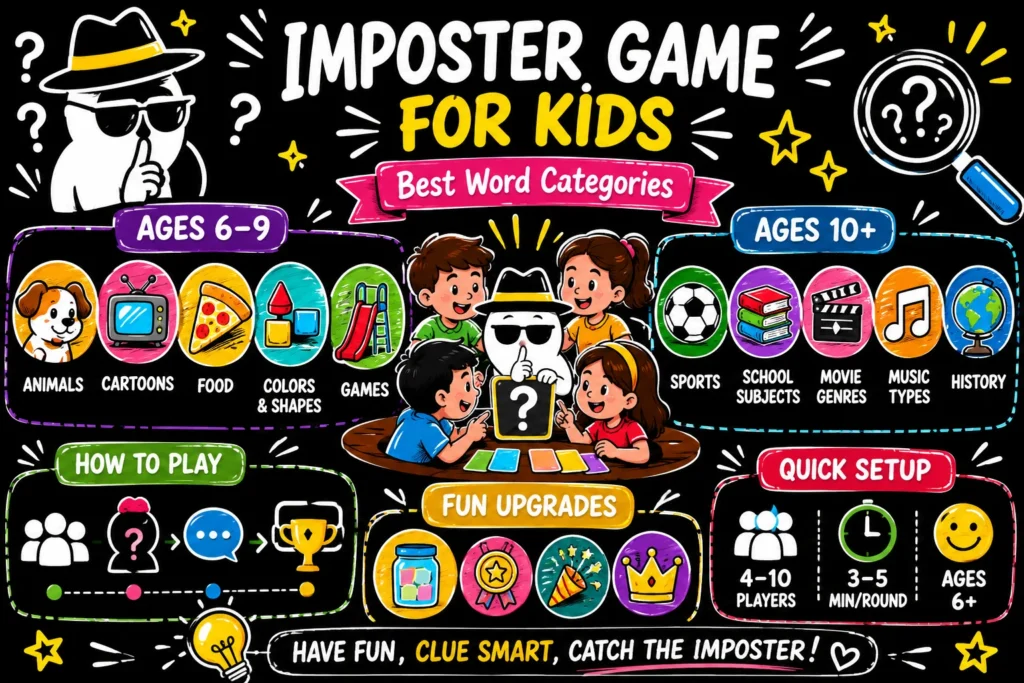
Best Word Categories for Kids’ Imposter Game
This is genuinely the most important part, and most people get it wrong by starting with categories that are either too hard or so easy they kill the suspense.
Categories That Work Brilliantly for Ages 6–9
Start with concrete, visual things kids can picture immediately. Animals are the gold standard — every child has an opinion about animals, which means their clues feel natural and the imposter has enough general knowledge to fake it semi-convincingly.
Other strong starter categories:
Cartoon characters, SpongeBob, Doraemon, and Bluey kids have strong associations and give surprisingly specific clues
Foods, especially junk food and snacks, which every child has feelings about
Colours and shapes sound basic, but for younger kids, this creates genuinely tricky clues
Playground games, hide and seek, tag, and hopscotch, are familiar territory with lots of descriptive angles
Categories That Work for Ages 10 and Up
Once kids have the hang of it, push into slightly more abstract territory. School subjects work well here, math, science, and art classes, because the associations are shared, but the clue options are wider. Sports are excellent because even non-sporty kids know enough to fake a clue about football or cricket.
Genres such as action, comedy, and horror make for very intriguing circles as well, since the hints take on a much more emotional and interpretive level. This allows the impostor more leeway to be successful in bluffing, keeping children interested rather than frustrated.
How to Set Up and Run the Game for Younger Players
The standard online version works fine for adults, but with kids under nine, you’ll want to tweak a few things.
First, read the word aloud to everyone except the imposter rather than showing it on a screen. Young children aren’t always fast readers, and the awkward pause as someone sounds out a word can give the imposter unintentional hints about who’s struggling.
Second, shorten the clue order. With young kids, go around the circle once, not twice. Two full rounds of clues overload the discussion phase, and kids lose the thread. One pass, then vote. Keep it tight.
Actually, scratch that for groups with older kids mixed in. If the age group of the players working with you is mixed, some of them are males and others are females, then the first round works for the younger players. The fix is simple: let older kids give two clues per turn, and younger ones give one. Levels the field without anyone feeling singled out.
Age-Specific Tips: What Works at 6, 10, and 13+
Ages 6–8: Keep rounds short and categories visual. Let kids pass once without penalty. Forced clues from very young children who genuinely can’t think of anything create frustration, not fun. Also, don’t make it competitive. The goal at this age is to laugh, not to win.
Ages 9–12: And this is where the fun of the Imposter Words Game for Kids kicks in. They’re mature enough to think and scheme, yet they’re still thrilled by their success. Introduce the “imposter wins by guessing the word” rule at this stage as an additional dimension to the voting process.
Ages 13+: Teenagers need harder categories and faster rounds. They’ll get bored with animals in about three sessions. Move into abstract categories: emotions, historical events, types of music. Also consider the double imposter variant, two impostors who don’t know each other. Teenagers love the paranoia spiral that it creates.
Game Night Upgrades: Making It More Fun Every Round
1. Build a category jar
Write 20–30 category names on slips of paper, fold them up, and let a different child draw one each round. Ownership of the category choice creates instant investment in the round.
2. Add a “challenge” token
Each player gets one token per game. They can use it to challenge someone’s clue mid-round, forcing that person to give a second clue immediately. Kids go absolutely wild for this power.
3. Theme entire sessions
A full Cartoon night, a Disney night, a food night. When every category connects to one theme, the rounds feel like episodes in a series rather than isolated games. Harder to do spontaneously, but worth the five-minute setup.
4. Let the caught imposter set the next category
Small consolation prize that also keeps eliminated players engaged rather than sitting there waiting. The timing matters. A lot, actually, a bored eliminated child will start coaching their sibling, which derails everything.
5. Play the first round with an obvious imposter on purpose
Assign the imposter role to a parent or older sibling and let the kids catch them easily. Builds confidence, explains the mechanics through experience, and gets everyone laughing before the stakes go up.
Mistakes Parents and Hosts Keep Making
Starting with abstract categories
“Emotions” or “things that are heavy” sound interesting, but land badly with younger kids who need something concrete to build a clue from. Start visual, go abstract only after three or four rounds of warm-up.
Letting older kids dominate the discussion phase
One twelve-year-old can accidentally steamroll three eight-year-olds in sixty seconds. The game stops being fun for the younger players, and they mentally check out. The moderator’s job is specifically to make sure every voice gets a moment.
Skipping the imposter-guesses-the-word rule
A lot of people running the game for the first time leave this out because it seems complicated. But, and this is important, without it, getting caught feels like a dead end. With it, the final ten seconds of every round are genuinely electric. Worth explaining upfront every single time.
Playing too many rounds in one sitting
Six rounds feel like the natural stopping point for most kids. Push past eight, and you’ll notice energy dropping and clues getting lazy. End while everyone still wants one more round. That’s the sweet spot.
Frequently Asked Questions
Conclusion
The imposter game for kids gets better the more you play it, not because the rules change, but because kids get sharper, categories get more creative, and the bluffing gets genuinely impressive.
Pick two or three categories from this list for your first session, keep rounds short, and let the kids set the pace. Don’t over-explain the strategy; they’ll figure it out faster than you expect.
And if a child beats every adult at the table on their first try? Honestly, just let them have that one.