Imposter Game for 3 Players: Tips & Tricks
Three people. One secret. Zero mercy.
That’s the entire premise of the imposter word game when you strip it down, and honestly? Playing it with exactly 3 players hits different. It’s more intense, more personal, and way harder to hide than in a group of eight.
Quick Answer:
The imposter game for 3 players is a word-based social deduction game where one player gets a different word while others share the same one. With only 3 players, bluffing becomes critical; there’s nowhere to hide. The imposter must blend in using vague clues, while civilians must spot the odd one out fast.
What Actually Happens in a 3-Player Imposter Game
Most people discover this game at a party with ten people and think smaller groups won’t work. They’re wrong, actually, scratch that. Small groups don’t just work; they’re where the real psychological warfare begins.
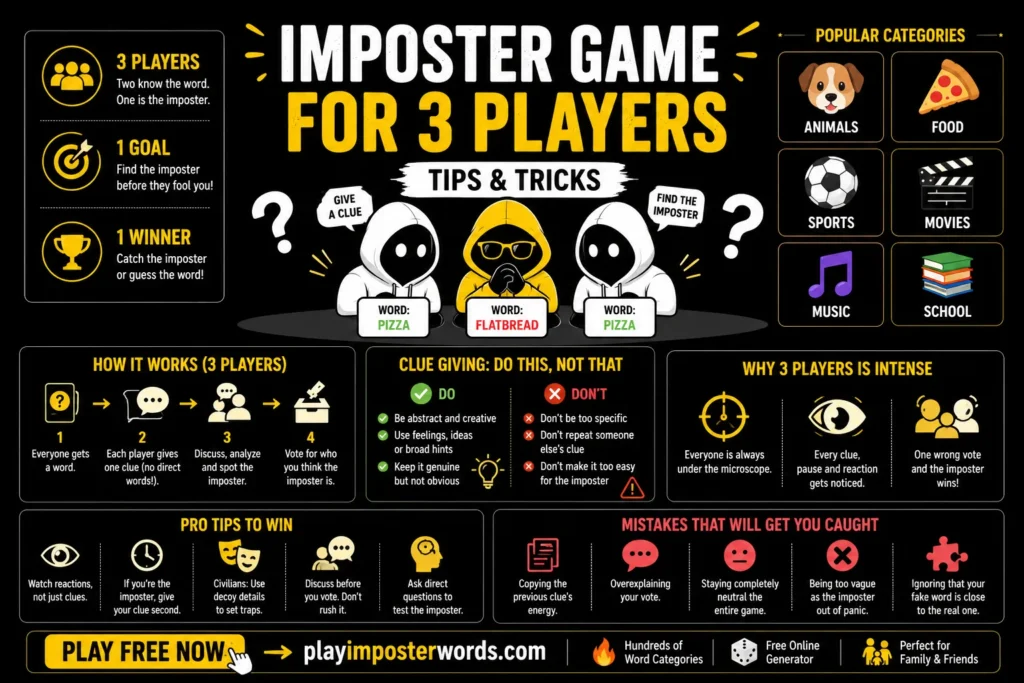
Here’s the basic setup: everyone gets a word.
Two players share the real world. One player, the imposter, gets a fake, similar word. Let’s say the real word is “Pizza” and the imposter gets “Flatbread.” Each player gives one clue about their word without saying it directly. Then everyone votes on who they think the imposter is.
Simple on paper. Brutal in practice.
What makes the imposter word game for 3 players uniquely tense is the math. With 3 people, your vote carries massive weight. One wrong accusation and the imposter walks free. One clever bluff and an innocent person takes the fall.
Imposter Game for 3 Players: Why 3 Players Change Everything
In larger groups, you can stay quiet for a round. Blend into the background. Let other people argue while you figure out what’s going on.
Not here. With only 3 players, every single person is under the microscope from word one. There’s no crowd to disappear into. The timing matters. A lot, actually.
If you pause too long before giving your clue, both other players notice. If you answer too fast, they wonder if you rehearsed it. That tiny window between “natural” and “suspicious” gets razor-thin when only two pairs of eyes are watching you.
And here’s the thing: the civilian dynamic shifts completely. In a 10-player game, civilians have safety in numbers. In a 3-player imposter game, civilians are just as exposed as the imposter. One of them might accidentally give a clue that sounds more suspicious than the actual imposter. I’ve seen it happen. Genuinely painful to watch.
How to Give Clues Without Giving Yourself Away
This is where most players lose the game before the vote even happens.
The biggest mistake? Being too specific. If the word is “Coffee” and you say, “It wakes me up in the morning,” you’ve basically handed over the answer. The imposter can now piggyback on your clue and survive the round.
So what works instead?
Go abstract. Go emotional. “It’s something I associate with comfort” works for Coffee, Tea, Hot Chocolate, and keeps the imposter guessing, too. You’re giving a real clue to the other civilian without creating a roadmap for the imposter to follow.
I remember one round where the word was “Guitar,” and someone said, “It has strings.” The imposter who had “Violin” nodded along perfectly. Nobody caught it. The lesson there was obvious: clues that are too broad protect the imposter, not just the civilians.
The sweet spot is a clue that’s genuine enough to prove you know the word, but layered enough that it doesn’t immediately confirm the category. Think of it like describing a movie without naming the genre.
Pro Tips: Outsmart Everyone at the Table
- Watch the reaction, not just the clue. When someone else gives their clue, the imposter often reacts slightly differently, a micro-nod, a glance, a small pause before responding. You’re not just listening in this game. You’re watching.
- As the imposter, give your clue second: never last. Going last as the imposter is a trap. You’ve heard both clues, which helps you blend in, but the other players know you had that advantage. Going second feels more natural and less calculated.
- Introduce a decoy detail. Civilians can throw in a slightly unusual clue on purpose, something that’s still accurate but sounds mildly off. If the imposter tries to copy that energy, they’ll sound even more suspicious. It’s a trap worth setting.
- Don’t vote too fast. Snapping to a vote immediately signals that you already had a suspect in mind, which either means you’re very perceptive or you’re the imposter trying to control the outcome. Either way, it draws attention. Take a breath. Discuss first.
- Use the 3-player structure against the imposter. Since there are only three of you, ask the other civilian directly: “Does my clue make sense with your word?” The imposter can’t answer that honestly, and their response (or hesitation) often tells you everything.
Mistakes That Will Get You Caught Immediately
Copying the previous clue’s energy too closely
This is the number one imposter tell. If someone says “It’s warm and relaxing,” and you immediately say “Yeah, mine’s also warm and cozy”, you’ve just shown your hand. Original clues only.
When the vote happens, innocent players usually say something like “I just felt off about your clue.” Guilty players, actually, impostors tend to build elaborate logical cases for why someone else is suspicious. Too much reasoning feels rehearsed.
Staying completely neutral the whole game
Some players think that saying nothing controversial keeps them safe. But in a 3-player imposter game, being too neutral is suspicious on its own. You need to have at least one mild opinion or reaction. Robots don’t win this game. (I tried. Didn’t work.)
Forgetting that your fake word is close to the real one
Impostors sometimes panic and go too vague because they’re scared of being wrong. But your fake word was chosen because it’s similar to the overlap. That’s your cover.
Frequently Asked Questions
Final Thoughts
So here’s where this lands. The imposter game for 3 players rewards the people who actually pay attention, not just to words, but to behavior, timing, and reaction. The clue you give matters. But the face you make when someone else gives theirs? That might matter more.
Play a few rounds, and you’ll stop thinking about what to say. You’ll start thinking about what not to show.
That’s when the game gets genuinely interesting.