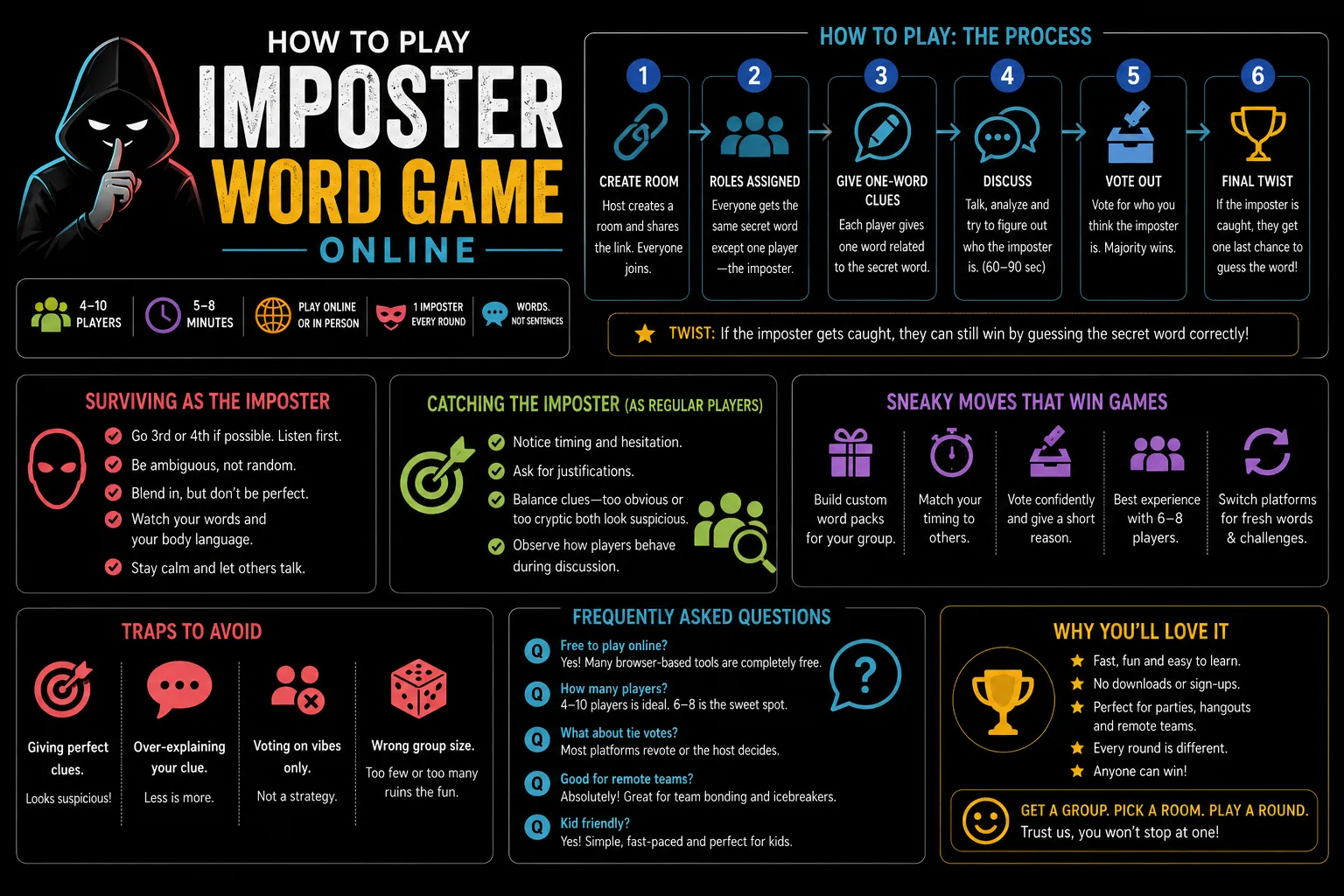
Best Imposter Game Words List (100+ Words)
The worst imposter game words round I ever played lasted four minutes. The word was “umbrella”, and every single clue was so obvious that the imposter, my friend who had nothing guessed it on the second clue and walked away looking like a genius. That’s what bad word selection does. The right words make rounds last, create arguments, and produce the kind of chaos that makes everyone want to play again immediately.
Quick Answer:
The best imposter game words sit in the middle ground, familiar enough that everyone can describe them, but specific enough that a vague clue won’t give the game away instantly. Strong categories include food, nature, sports, household items, and pop culture. This list covers 100+ words organised by difficulty and category, with tips on which work best for different group types.
What Makes a Word Good or Bad for the Imposter Game
Not every word deserves a spot in your rotation. This sounds obvious, but people ignore it constantly and then wonder why their round was over in ninety seconds.
A good imposter game word has three qualities. It’s recognisable to everyone in the group. It has multiple angles of description, so clues naturally vary. And it lives in that specific zone where a confident clue sounds suspicious, and a vague clue sounds like you don’t know it.
“Dog” fails the test. Everyone gives the same three clues: pet, bark, four legs, and the imposter figures it out immediately. “Greyhound” is better. People describe it differently: speed, racing, bus company, the shape of the dog. That variation is what creates doubt.
Honestly? The single most underrated quality in a word is divisibility. Can it be described from wildly different angles? “Coffee” can be described by its smell, its effect, the ritual of making it, the colour, and the culture around it. That’s a good word. “Chair” gives you legs, sitting, furniture. Less range, shorter round.
And that’s exactly why category matters as much as the word itself.
How to Play the Imposter Word Game
Best Imposter Game Words by Category
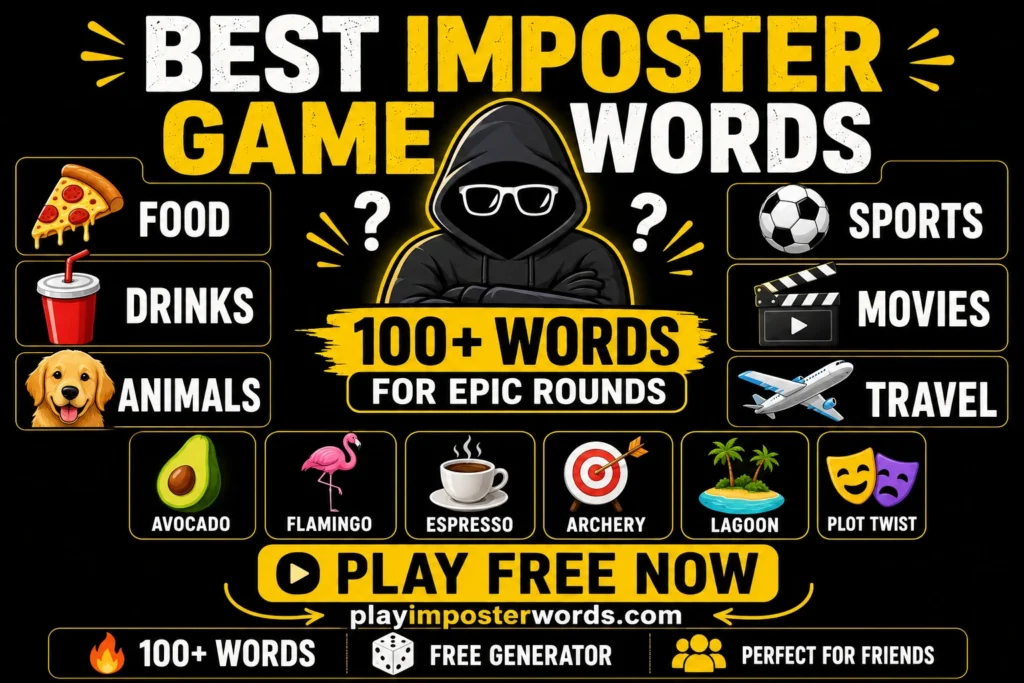
Here’s the full list, broken into categories that work for most groups. Pull from whichever section fits your crowd.
Food and Drink
Easy to describe from multiple angles: smell, taste, texture, occasion, colour. Reliable category for mixed groups. Avocado, Sushi, Espresso, Croissant, Taco, Smoothie, Ramen, Pretzel, Mango, Nachos, Sourdough, Tiramisu, Cinnamon, Waffles, Sriracha, Kombucha, Boba, Kimchi, Lasagna, Matcha
Nature and Animals
Works across age groups. Animals with strong personality traits create the best rounds. Flamingo, Cactus, Avalanche, Coral Reef, Firefly, Monsoon, Redwood, Piranha, Pangolin, Stalactite, Eclipse, Tsunami, Hummingbird, Quicksand, Tumbleweed, Aurora, Centipede, Mangrove, Vulture, Glacier
Sports and Activities
Best for groups who share a sporting culture. Avoid hyper-specific terms if the group is mixed. Surfing, Marathon, Archery, Penalty Kick, Slam Dunk, Fencing, Overtime, Pole Vault, Ref Whistle, Starting Pistol, Hat Trick, Podium, Hurdles, Dive, Backflip, Knockout, Baton, Sparring, Draft Pick, Scoreboard
Household Items
The meta category is secretly one of the funniest. Describing everyday objects without saying them is harder than it sounds. Blender, Shower Curtain, Ironing Board, Doorbell, Thermostat, Laundry Basket, Corkscrew, Dustpan, Throw Pillow, Extension Cord, Toothpick, Colander, Coat Hanger, Stapler, Squeegee, Kettle, Tupperware, Clothespeg, Toilet Brush, Doorstop
Pop Culture and Entertainment
High-energy rounds. Works brilliantly for groups that watch the same things. Heist Movie, Plot Twist, Cliffhanger, Netflix Binge, Jump Scare, Blooper, Cameo, Reboot, Soundtrack, Trailer, Sequel, Binge-Watching, Credits Scene, Spoiler, Meme, Fan Theory, Cliffhanger, Recast, Spinoff, Livestream
Places and Travel
Opens up a debate instantly. Best for groups who travel or talk about travel a lot. Gondola, Checkpoint, Red Eye Flight, Hostel, Layover, Bazaar, Passport Control, Lagoon, Safari, Fjord, Souvenir, Timezone, Hammock, Cobblestone, Time Zone, Hostel, Checkpoint, Jungle Trek, Rooftop Bar, Capsule Hotel
Words Ranked by Difficulty Level
Not every group plays at the same level. Here’s how to match word difficulty to your players.
| Difficulty | Example Words | Best For |
| Easy | Pizza, Cat, Rain, Car, Tree | First-time players, kids, ice-breakers |
| Medium | Flamingo, Espresso, Marathon, Hostel | Most adult groups, office teams |
| Hard | Stalactite, Squeegee, Fjord, Boba | Experienced players, competitive rounds |
| Expert | Pangolin, Mangrove, Capsule Hotel, Kombucha | Groups who’ve played 10+ times |
Starting on expert difficulty with new players is the fastest way to end a game night early. Nobody enjoys feeling confused in a social setting; they just go quiet and stop participating. Medium difficulty keeps rounds competitive without making anyone feel left behind.
Special Rounds: Themed Word Lists That Change Everything
Standard rounds get predictable fast. Themed rounds reset the energy completely.
Food Only Round: Every word comes from the food and drink list. Clues get weirdly specific and funny. Someone will describe “cinnamon” as “your grandmother’s house smell”, and everyone will immediately know the word.
Household Objects Round: this one creates genuine arguments. People disagree on how to describe a squeegee. That’s a feature, not a bug.
Abstract Round: words that aren’t physical objects. Try: Nostalgia, Procrastination, Jealousy, Momentum, Anxiety, Ambition, Guilt, Anticipation. These rounds run long and get philosophical in the best way. (My personal favourite, though I’ll admit they’re not for every group.)
Actually, I take that back. They are for every group. You just need one warm-up round first.
Decade-Themed Round: all words from one decade. 90s round: Dial-Up, VHS, Pager, Tamagotchi, Blockbuster, JNCO Jeans. 2010s round: Selfie, AirPods, Uber, Bitcoin, Netflix, TikTok, Avocado Toast. Decade rounds create instant nostalgia and debate.
Tips for Picking Words That Actually Create Drama
- Test the word against the “multiple angle” rule before using it
Ask yourself: can this word be described from at least four different angles: appearance, function, feeling, association, sound? If yes, it’s a good word. If the only angles are shape and colour, skip it. - Use words that the imposter can plausibly bluff
The best rounds aren’t the ones where the imposter gets immediately exposed; they’re the ones where the vote is split. Pick words where a confident, vague clue could go either way. “Storm” is too easy to bluff. “Monsoon” is better; it has specificity that forces real knowledge. - Seasonal and topical words add urgency
“Christmas Tree” in December creates different energy than in July. “Summer” in August feels immediately alive in a way it doesn’t in winter. Match your word list to the moment when it matters. - Rotate categories between rounds
Two food rounds in a row make the third round predictable; players assume it’s food again, and the imposter has an easier bluff. Switching categories resets expectations and forces everyone to recalibrate. - Retire words after they’ve been used twice
Once a group has played “Flamingo” twice, they’ve developed shared shorthand for describing it. The third time, clues get stale, and the round loses tension. A word list only stays sharp if it keeps rotating.
Word Selection Mistakes That Ruin Rounds
Using words with only one obvious clue
“Red” as a word sounds fun. It isn’t. Every player says “colour” or “stop sign”, and the round ends in forty-five seconds. Monodimensional words produce monodimensional rounds. The imposter barely has to try.
Going too obscure too fast
There’s a version of this game where the host thinks they’re being clever by using “Palaeontologist” or “Thermodynamics.” Nobody enjoys this. The imposter doesn’t know the word. The civilians can’t give clues without saying the word. The round collapses. Obscure ≠ hard. It just means uncomfortable.
Picking words that only some players know
This is the quiet killer of mixed groups. A word like “Boba” works brilliantly in a city with bubble tea shops everywhere. It fails in a group of three people who’ve never heard of it. Read your room. The best imposter game words are ones where everyone at the table has an opinion.
Repeating the same category three rounds running
Groups self-limit when the category gets predictable. The clue-giving gets lazy, the imposter spots patterns faster, and rounds get shorter. Mix it up every single time.
Frequently Asked Questions
Conclusion:
Word selection is the part of this game that most people underestimate and then wonder why some rounds are electric, and others fall flat in three minutes. Pull from this list, test the multiple-angle rule, and rotate categories every round. Start with medium difficulty and move up as the group finds its rhythm. The best round you’ve ever played is probably one good word away.