
Imposter Game for Students: Classroom Edition
Imposter Game for Students: A substitute teacher once told me the class went completely silent, not because she yelled, but because she pulled out a word game and said one person in the room was lying. Twenty-three eighth-graders suddenly had opinions, eye contact, and something to say. The imposter game for students does that. Every single time.
Quick Answer:
The imposter game for students is a social deduction word game where most players get the same secret word, and one student (the imposter) gets a different or no word. Students discuss and vote to find the imposter. It builds critical thinking, speaking confidence, and classroom engagement, and it runs free at playimposterwords.com with zero setup.
What Makes the Imposter Game Work in a Classroom
Most classroom games fail the same way: they’re fun for five kids and background noise for everyone else. The imposter word game sidesteps that completely because everyone has a role, and no one knows who the threat is.
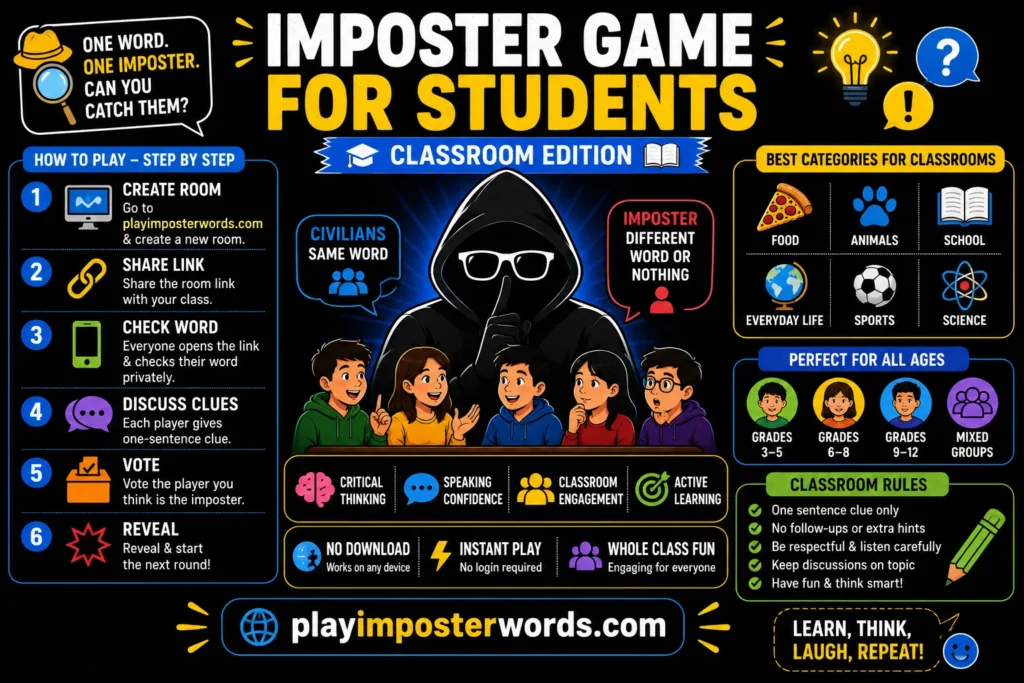
Here’s the thing: the game works on a genuinely simple mechanic. Students are split into civilians (who all get the same secret word) and one or two impostors (who get a different word or nothing at all). Everyone gives a vague one-sentence clue about their word without revealing it. Then the class votes on who they think is faking it.
What sounds like a party game is actually a disguised exercise in listening, logical deduction, and verbal precision. Students have to choose words carefully; they cannot be too vague, too specific, or give the word away. That tension? That’s exactly the kind of thinking teachers spend entire lesson plans trying to create.
And the social layer matters too. Shy students suddenly have a structured reason to speak. Dominant talkers have to actually listen to others to catch inconsistencies. The imposter game for students naturally redistributes classroom participation in a way that no seating chart ever managed.
Best Word Games for Classroom Engagement
How to Run the Imposter Game for Students Step by Step
The whole setup takes under four minutes. You don’t need to print anything, install anything, or create an account.
Step 1: Open the tool
Go to playimposterwords.com on the classroom computer or your own device. Click “Create New Room” and enter your name as the host.
Step 2: Configure the game
Choose the number of impostors (start with one for classes under 20 students), pick a word category appropriate for your age group, and set a discussion timer. Two minutes works well for most classroom rounds.
Step 3: Share the room code
The site generates a unique room link or code. Display it on the projector or board. Students open it on their own phones or tablets, each on their own device, so they see their role privately.
Step 4: Students peek at their roles silently
This is important. Each student checks their screen alone, without showing anyone. The word is displayed privately. The imposter either sees a different word or nothing at all.
Step 5: Discussion round begins
Going around the room (or in random order), each student gives exactly one sentence about their word. No follow-ups, no clarifications, just the one clue.
Step 6: Vote and reveal
Students vote on who they think the imposter is. The reveal happens on-screen. Reactions are immediate. Run another round with a new category.
The whole loop setup to reveal runs in about 8–10 minutes per round. Three rounds fit neatly into a 30-minute free period.
Best Settings and Categories for School Groups
Not every category works equally well in every classroom. A word like “tequila” showing up in a middle school game is the kind of thing that ends game nights early (or gets you a strongly worded email from a parent). The good news is that playimposterwords.com lets you use custom words, so you have complete control.
For younger students (grades 3–6), the Food and Animals categories are reliable. The words are universally known, descriptions come naturally, and there’s zero risk of something awkward slipping through.
For middle school (grades 6–9), the Everyday Life and Sports categories add more challenge. Students this age are better at strategic deception, so harder categories make the imposter’s job more difficult and the detective work more satisfying.
For high school and older students, custom word packs are where it gets genuinely interesting. Subject-specific vocabulary, literary terms for an English class, geography terms for social studies, turns the imposter game into an actual review activity. Students describing “photosynthesis” or “democracy” without saying the word is comprehension-checking in disguise.
|
Turn on the “give impostors a similar word” setting for any group older than grade 5. It makes the imposter’s job survivable and the game dramatically more fun for everyone.
Classroom Rules That Keep the Game Educational
Left without rules, the imposter game for students drifts fast; students start yelling, clues become unhelpfully abstract, and two confident kids dominate every round.
A few firm ground rules fix all of that.
One sentence only. Every clue is exactly one sentence. No elaborating when someone questions you. This forces precision and removes the advantage that loud students normally have.
No direct synonyms. You can’t describe “ocean” by saying “sea.” The game loses its challenge instantly if synonyms are allowed. Make this rule explicit before round one.
Raise hands before speaking during the vote. The discussion phase gets chaotic without structure. Keeping hand-raising as a rule during voting keeps it a classroom activity and not a shouting match.
The imposter can bluff; that’s the point. Some students get upset when the imposter deceives successfully. Address this early: lying strategically within the game is the game. It’s not personal. This is actually a great opening for a short discussion about context and intent.
Tips for Teachers: Making Every Round Count
- Run a practice round with the word revealed to everyone. Before the first real game, play one round where every student knows the word, including the imposter. This lets students get comfortable with clue-giving before the pressure of actually hiding anything. It prevents those first-round “I don’t know what to say” freezes.
- Use subject-specific custom words as a review tool. The custom word feature at playimposterwords.com lets you enter your own word pairs. Before an exam, run three rounds with vocabulary from the unit. Students are reviewing content without realizing it, and they’ll remember the word “mitosis” because Priya almost got away with describing “meiosis.”
- Debrief after the reveal, not just before the next round. Ask the class: “What clue almost convinced you?” or “What gave the imposter away?” This two-minute debrief builds metacognitive skills students start understanding their own reasoning, which is quietly one of the hardest things to teach.
- Let students host rounds. After two or three teacher-run games, hand the host role to a student. They set the category, manage the timer, and call on people. Responsibility changes the energy in the room. Students who host tend to stay more focused during rounds they’re not running. Funny how that works.
- Keep teams mixed. If students always play with their friend group, the social deduction element weakens because they already know each other’s tells. Randomize groupings when possible to keep the imposter game genuinely unpredictable.
Mistakes That Turn a Great Game Into a Mess
Starting with a category no one knows
Using advanced vocabulary in a category that half the class hasn’t encountered yet means civilian students struggle to give clues, and now they look suspicious through no fault of their own. The game stops being fair. Always match the category to what the class actually knows.
Skipping the one-sentence rule
This is the most common classroom mistake. Without it, one student rambles for forty-five seconds, others lose interest, and the imposter has time to figure out the word just from listening. Short clues only. The rule exists for a reason.
Letting the same students dominate voting
Some classes have two or three students who loudly declare their suspicions before anyone else has processed. The vote becomes theirs by default. Require silent written votes (or thumbs-up on devices) before anyone announces their pick. More students actually think. Better game.
Using it as a punishment-free period
The imposter game for students works best when it has a light structure, not when it’s thrown out as “just do whatever.” A few simple rules, a consistent format, and a brief debrief make it educational and fun. Without any structure, it’s just noise.
Frequently Asked Questions
Final Thoughts
The imposter game for students earns its place in a classroom because it’s the rare activity where engagement isn’t manufactured; it’s built into the game itself. Students want to catch the liar. That motivation does more work than most lesson plans.
Run it once, debrief properly, and let students host a round. You’ll know pretty quickly which student in your class is a terrifyingly good liar.
That information is useful. Probably.