Imposter Game vs Among Us: What’s the Difference?
Imposter Game vs Among Us: Both games are built around the same idea: someone in the group is lying to your face, and you have to figure out who. But “Imposter Game” and Among Us aren’t actually the same thing. One is a browser-based word game you play with real people in the room (or on a call), and the other is a downloadable video game with spaceships, tasks, and sabotage. Mixing them up is easy, especially since the word “impostor” shows up in both.
Quick Answer:
The main difference between Impostor Game and Among Us is format. Among Us is a digital video game played with animated characters completing tasks on a map, while the Imposter Game (like the one at playimposterwords.com) is a word-based party game played with real words, real conversation, and no installation required. Among Us needs an app; the Imposter Game just needs a browser.
What Is Among Us?
Among Us is a multiplayer video game where players control small animated astronauts on a spaceship or map. Most players are “Crewmates” assigned tasks to complete, while one or more players are secretly “Impostors” trying to sabotage the mission and eliminate crewmates without getting caught.
The game runs on phones, tablets, and PCs through an app or game client. Rounds involve walking around the map, completing visual tasks, and joining emergency meetings to vote out whoever seems suspicious. It’s visual, fast-paced, and leans heavily on watching player movement and behavior on screen.
What Is the Imposter Word Game?
The Imposter Game flips the format entirely. Instead of a digital map, players get assigned secret roles and secret words. Most players (the “civilians”) receive the real word something like “Pizza.” The imposter either gets a slightly different word, a related word, or nothing at all, depending on the settings.
From there, the game is pure conversation. Players describe their word out loud, one at a time, trying to prove they know it without saying it outright. The imposter has to blend in and guess what the real word might be, just from listening. No animation, no tasks, just words, voices, and a bit of social pressure.
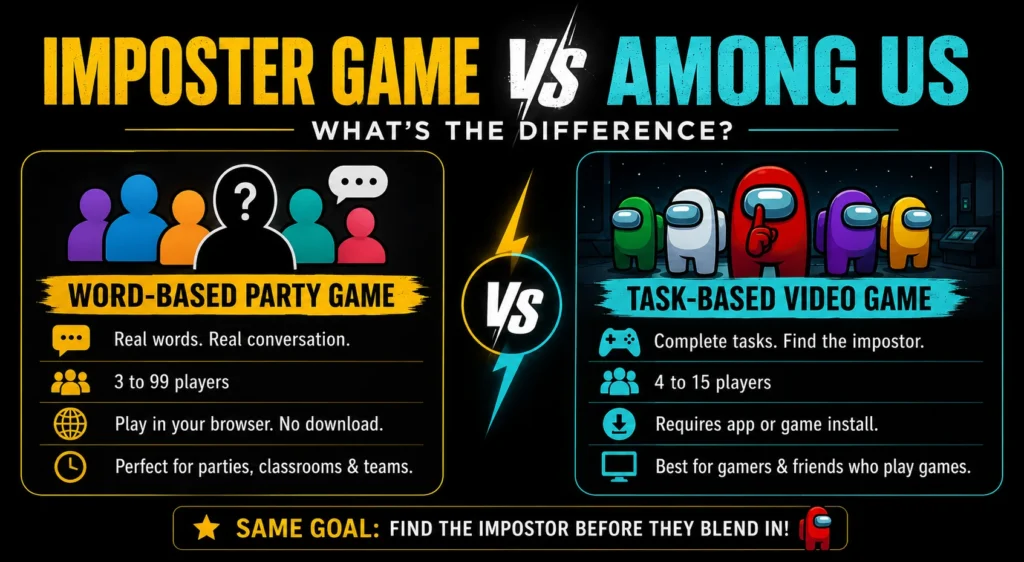
Imposter Game vs Among Us: Side-by-Side Comparison
| Feature | Imposter Game | Among Us |
|---|---|---|
| Format | Word-based, conversation-driven | Visual, task-based video game |
| Setup | Browser only, no download | Requires app/game install |
| Players | 3 to 99 | Typically 4 to 15 |
| Devices | Phone, tablet, desktop | Phone, tablet, PC |
| Best for | Parties, classrooms, remote teams | Friend groups familiar with gaming |
| Skill needed | Conversation and deduction | Navigation, timing, multitasking |
The comparison makes the Imposter Game vs Among Us question easier to answer once you separate “video game” from “party game.” They solve the same social itch, finding the liar through completely different mechanics.
Which One Should You Play?
If your group wants something fast, no downloads, works on any device with a browser, and doesn’t require gaming skill, the word-based Imposter Game wins. It works well for office team-building, classroom icebreakers, and family gatherings where not everyone is comfortable with a video game interface.
Among Us suits groups already into gaming, especially younger players or friend groups who enjoy the visual sabotage and task-completion loop. It needs a bit more setup time and a shared understanding of the controls, but the payoff is a more immersive, animated experience.
Setting Up the Perfect Round: Tips That Actually Help
- Match the word category to your group. Funny or pop-culture word packs work great for teens, while simple food and animal categories keep things easy for kids or mixed-age groups.
- Use the discussion timer. A 2-minute timer keeps the round moving and stops the game from dragging while one player overthinks their clue.
- Don’t reveal the impostor count upfront if you want extra suspense; not knowing how many imposters are hiding adds a layer of paranoid fun to the discussion phase.
- Start with fewer impostors for new groups. One impostor among five or six civilians is easier to manage for first-timers than a 50/50 split.
- Mix online and pass-and-play modes depending on who’s actually in the room. Remote friends can join the online room while local players use the same-device mode.
Mistakes That Ruin a Good Round
Picking word categories that are too obscure is a common one. If half the group doesn’t recognize the word, the round turns into confusion instead of deduction, and the imposter ends up blending in by accident rather than skill.
Skipping the discussion timer is another. Without a timer, one talkative player can dominate the round, and the rest of the group loses interest before voting even starts.
Letting players see each other’s screens defeats the entire point. The secrecy of the word reveal is what makes the imposter mechanic work; if someone glances over, the whole round is wasted.
Choosing too many impostors for a small group also backfires. With three or four players and two impostors, deduction becomes nearly impossible, and the game stops feeling fair.
Frequently Asked Questions
Final Thoughts
The short version: Among Us is a video game, the Imposter Game is a word game, and the only thing they really share is the word “impostor” and the basic premise of spotting a liar in the group. If your priority is zero setup, browser access, and pure conversation-based deduction, the Imposter Game fits better, especially for mixed-age groups or remote teams. If you want animated characters, tasks, and a more traditional gaming experience, Among Us is the one to install.
Either way, the goal is the same: find the impostor before they find a way to blend in.