
Imposter Game for Office Teams: Team Building
Nobody expects the quietest person in the office to be the best liar. But get them into a round of the Imposter Game for Office, and suddenly they’re convincing everyone that “sunrise” is their word when they haven’t got a clue. That’s the magic of this game and why it’s quietly becoming one of the most popular team-building activities in workplaces right now.
Quick Answer:
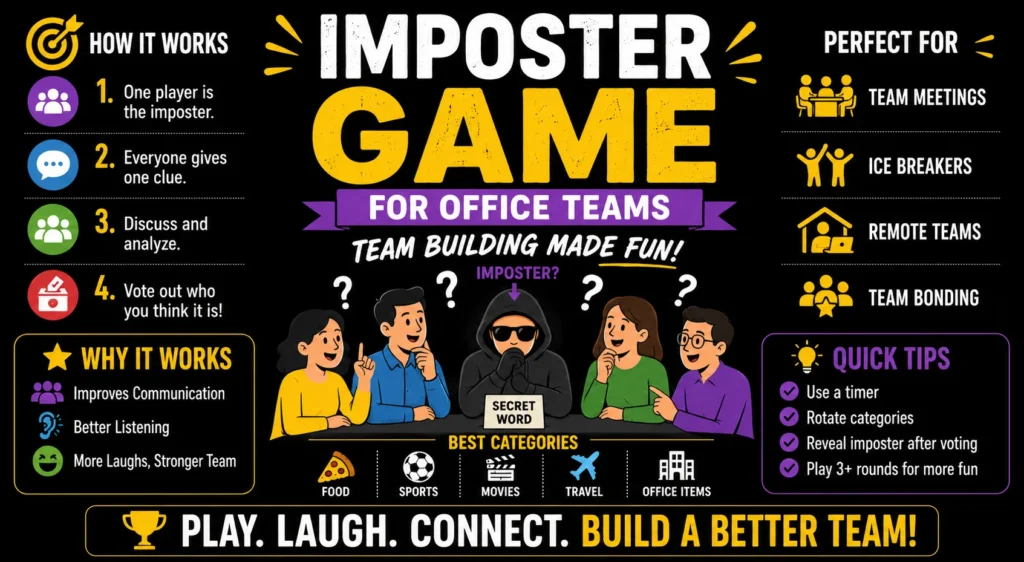
The imposter word game is a social deduction activity where one player gets a different word or no word while others share the same secret word. Players give clues, discuss, and vote out the imposter. For office teams, it builds communication, sharpens listening skills, and creates genuine laughs. No equipment, no budget, no awkward trust falls required.
Why the Imposter Game Works Better Than Most Team Building Activities
Most office team-building activities have a problem. People know they’re being forced to bond, and that awareness kills the whole thing before it starts. The ropes course. The trust fall. The personality quiz is followed by a debrief that runs 40 minutes over schedule.
The imposter word game sidesteps all of that. It doesn’t announce itself as a team-building exercise; it announces itself as a game. And that difference matters more than any HR consultant will tell you.
Here’s the thing: when people are focused on catching a liar, they stop performing. They listen. They watch. They read between the lines. Those are exactly the skills that make teams function well, and the game develops them without anyone realizing it’s happening.
I’ve seen this work in a team of seven developers who barely talked during standups. Two rounds in, and they were debating whether the “galaxy” clue was suspicious or not. Nobody was checking their phone.
And that’s exactly why the imposter game for office teams keeps coming up in conversations about low-effort, high-impact activities. It creates real interaction without requiring anyone to pretend they’re enjoying a worksheet.
How to Run It With Your Office Team: Step by Step
Setup takes under three minutes. No apps required, though there are free online generators that handle the word assignment automatically if you’re running it remotely.
For in-person play, the host picks a secret word and whispers it to all players except the imposter. The imposter either gets a vague related word or nothing at all, depending on which version you’re playing. Everyone then gives one clue about their word without saying it directly. Discussion follows, then a group vote.
Running It on Zoom or Remote Teams
Remote play works surprisingly well. Use a free imposter word game generator. Players join a shared room, and the tool assigns roles to each person’s individual screen. No word gets accidentally revealed.
The host controls the discussion timer, which is worth setting at two minutes for work groups. Office rounds tend to go quiet without a timer because people are more cautious about calling out a colleague than they would be with friends. A countdown fixes that instantly.
Actually: scratch that. Two minutes might be too short at first. For a team playing together for the first time, give it three. Once they’ve played a few rounds, two minutes creates the right pressure.
Best Word Categories for Workplace Settings
Category choice changes everything in an office context. Go too niche, and one person wins because of specialist knowledge. Go too broad, and the clues become identical and boring.
The sweet spot for office teams is shared cultural territory, things everyone in the group would know, regardless of their role or department.
|
Office items, as a category, deserve a mention. “Stapler” sounds boring. But watching someone try to describe a stapler without saying it while an imposter bluffs using the word “clipboard” they guessed from context, is genuinely funny in a way that most office moments aren’t.
What the Imposter Game Actually Teaches Your Team
This is where it gets interesting, and where the game earns its place as a serious team-building tool rather than just a fun distraction.
The game forces players to think about how they communicate under pressure. Giving a clue that’s specific enough to prove you know the word but vague enough not to hand it to the imposter requires precision. That kind of thinking translates directly into how people write emails, give feedback, and explain problems in meetings.
And listening. The timing matters. A lot, actually. Players who pay attention to when someone hesitates before giving their clue or who notice that one person’s clue could fit three different words start developing habits that make them better collaborators.
I once played this with a marketing team, and the head of content, someone known for talking a lot in meetings, went completely quiet during discussion rounds. She said afterwards she was so focused on listening that she forgot to perform. That’s rare. And valuable.
So yes, it’s a word game. But it’s also a low-stakes environment for practicing skills that are genuinely hard to teach.
Tips That Make Office Rounds Actually Fun
- Start with an easy category before getting competitive.
First-time players need a round to understand the rhythm. Food or animals work well; everyone knows the territory, and the imposter has enough to work with. Jumping straight into obscure categories makes the first round confusing rather than fun. - Let the imposter reveal themselves after voting, even if they win.
This single rule changes everything. Knowing who the imposter was (and hearing how they bluffed) creates a five-minute debrief that’s more engaging than most team meetings. People love the reveal. - Rotate who picks the category.
When the same person always chooses, the game skews toward their knowledge. Rotating keeps it fair and gives quieter team members a moment of low-pressure control. Sounds small. It isn’t. - Use a timer every round without exception.
Without a timer, office rounds stall. People are polite at work in ways they aren’t with friends. A visible countdown creates permission to speak up the clock removes the social awkwardness of cutting someone off. - Play at least three rounds before stopping.
One round isn’t enough to see what the game can do. The second and third rounds are where people relax and start playing strategically rather than cautiously.
Mistakes That Kill the Vibe at Work
Letting seniority dominate the discussion
This happens fast and ruins the game. When the most senior person in the room speaks first every round, everyone else defers. Set a rule early: clues go around in a fixed order, and discussion starts with whoever didn’t speak last. It levels the dynamic without anyone having to say why.
Choosing words that are too inside-baseball
A word that only one department would know immediately tells the imposter they’re out of their depth and tells the group who knows the word. The game needs words that sit in the middle ground. Everyone should have something to say.
Treating it as a competition instead of a conversation
Some teams get so focused on catching the imposter that the game stops being fun. But the imposter word game for office teams works best when the process the clues, the debate, and the reveals matter more than the winning. If someone’s keeping score obsessively after round four, it might be time to switch categories.
Frequently Asked Questions
Conclusion:
The imposter word game works for office teams because it doesn’t try to be a team-building exercise. It’s just a game, and somewhere inside that game, people start paying attention to each other in ways that matter.
Start with one round at the end of your next team meeting. Keep the category simple. Set a timer.
The quiet one will probably win. They usually do.